
This Inglorious Indian War
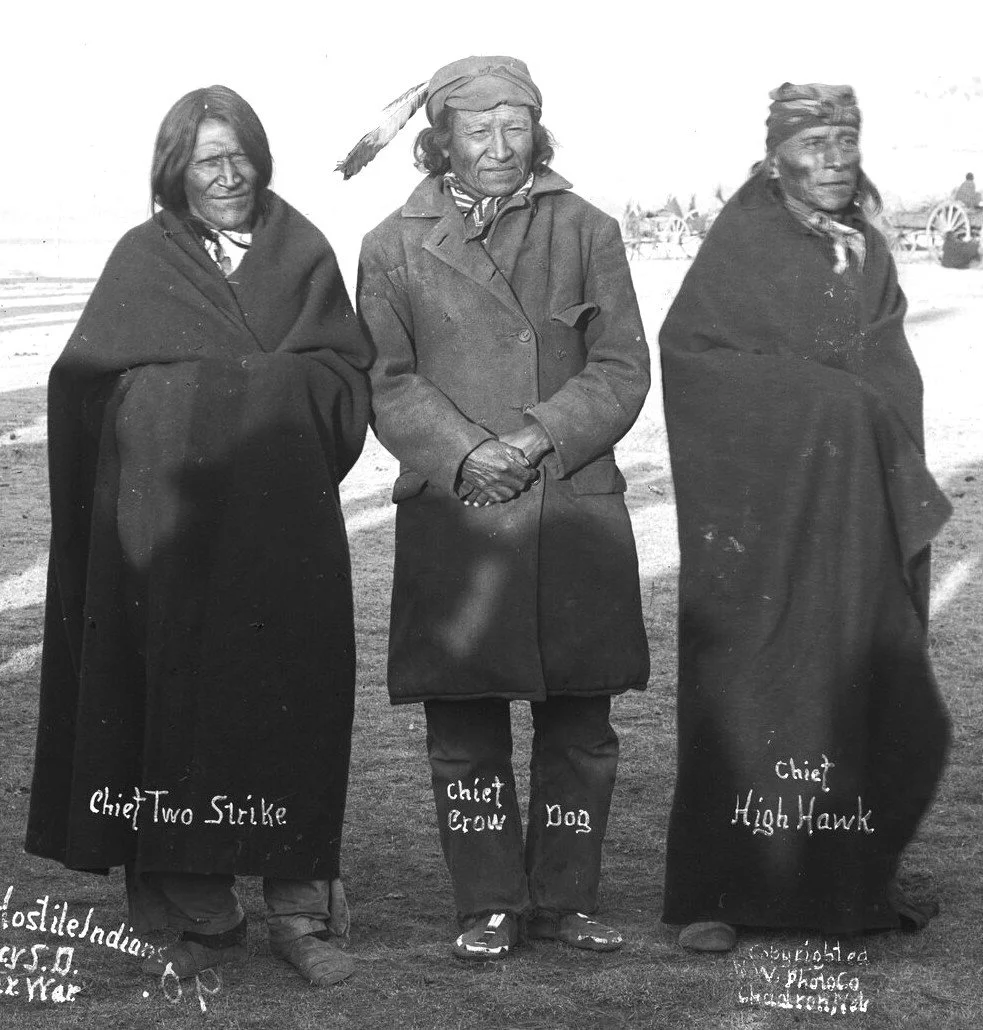
On November 17, 1890, Major Guy V. Henry of the 9th Cavalry, commander of Ft. McKinney, Wyoming, received a telegram ordering him to the Pine Ridge Reservation in South Dakota. Two days later, Henry and D Troop of the 9th Cavalry, commanded by my great-great-grandfather Cpt. John S. Loud, set off on the roughly 300-mile journey to the lands of the Lakota people. The 9th Cavalry’s D Troop were not the only soldiers ordered to proceed to South Dakota at that time.
Morledge, C. G. 1890-91. Chief Two Strike, Chief Crow Dog, and Chief High Hawk, Leaders of Hostile Indians at Pine Ridge Agcy S.D. During the Late Sioux War. Image from Denver Public Library Special Collections, X-31414.
Over the next month, a force of around 3,500 soldiers—infantry, cavalry, and artillery—occupied the Lakota reservations in the state, an enormous military build-up for that era and the largest force assembled in the United States since the end of the Civil War 25 years earlier (Greene 2014).
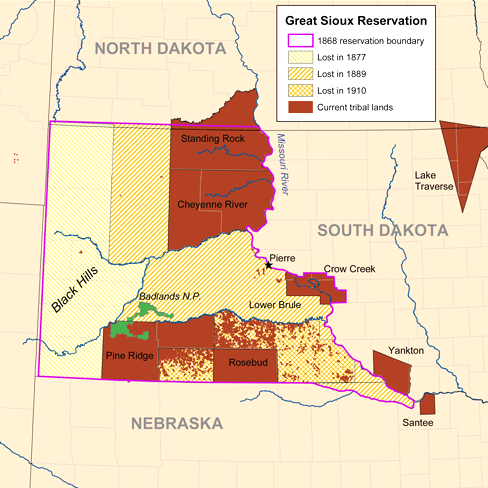
The reason given for the military occupation was the possibility that the Lakota people were planning to launch an attack, although it was unclear exactly who they intended to attack or when. There was undoubtedly a lot of unhappiness among the Lakota at that time. In the years since the Great Sioux War, they had lost much of their tribal land, including 9 million acres ceded to white settlers only the year before as a result of the Dawes Act (see map).
Musser, Karl. 2008. Map of the Great Sioux Reservation Showing Land Lost from 1868 to Present. Image from Wikimedia Commons.
The U.S. government had also reneged on its promise to provide the tribe with adequate rations. Cut off from their traditional hunting lands and cheated by the U.S. government, the Lakota people were angry and miserable, and as a result, some had turned to the Ghost Dance, a religious ritual that seemed to offer hope of a better future (Richardson 2010; Greene 2014).
The people who had the most contact with Native Americans—army officers, Indian agents, and even the settlers who drove to nearby reservations to watch the dancing—were largely unconcerned by the Ghost Dance movement, assuming it would die out in time. One notable exception to this attitude was Daniel F. Royer, a political appointee who had no experience with the Lakota people and was the new Indian agent at the Pine Ridge Reservation. By the time Royer arrived at the reservation in October 1890, the Ghost Dance movement had taken firm hold there. Royer, in a panic, repeatedly contacted the Commissioner of Indian Affairs in Washington, DC, insisting that hostilities were imminent and military intervention was greatly needed. Soon after, the Army sent troops to the region to quell the supposed uprising and end the practice of the Ghost Dance (Ostler 1996; Richardson 2010; Greene 2014).
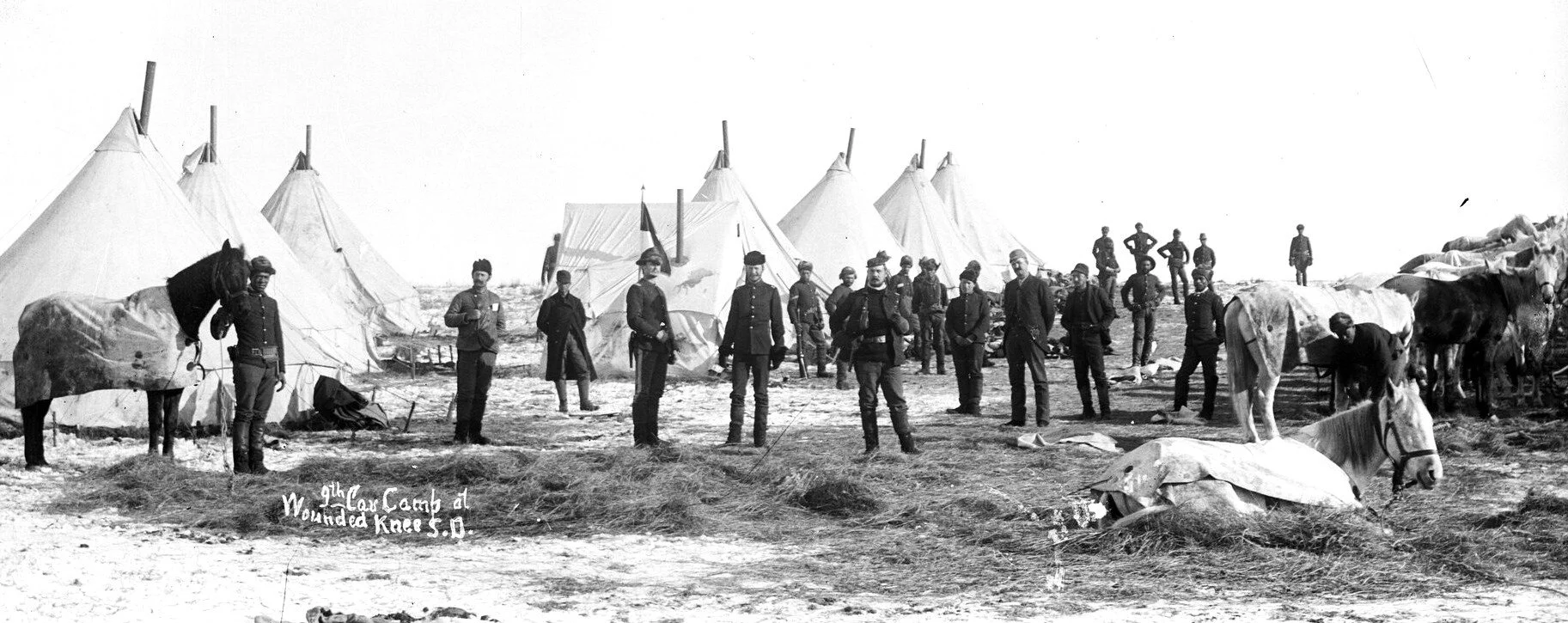
9th Cav. Camp at Wounded Knee S.D. 1890-91. Image from Denver Public Library Special Collections, X-31418.
When Army troops began to pour into South Dakota, thousands of the Lakota fled their reservations, fearing arrest or attack. At the same time, Lakota people who had not embraced the Ghost Dance came to the reservation agencies in large numbers, seeking reassurance that the army would not harm them. Amidst this confusion, the army was tasked with locating various Lakota groups and escorting them back to their homes or holding them at army forts. This effort was initially effective, and the absence of any large-scale fighting calmed many fears (Richardson 2010). My great-great-grandfather John Loud, in a letter to his daughter written on December 18, 1890, expressed his hope that the worst was over, saying:
The Indians of the two greatest reservations are now all under control and our Country undoubtedly Spared a costly and bloody war—and now if the Country will see that the Government redresses and keeps its promises—insuring [sic] the Indians their subsistence—there will be no trouble (Erisman & Erisman 1996).
This hopeful outcome was not to be. On December 29, as soldiers tried to take guns from a group of Lakota people, a probably accidental shot led to the Wounded Knee massacre, during which the army killed around 250 Lakota men, women, and children (Ostler 1996; Richardson 2010).
At the time of the massacre, Major Henry, Cpt. Loud, and four troops from the 9th Cavalry were stationed in an area northwest of the Pine Ridge Reservation, where ongoing negotiations with the remaining Lakota Ghost Dancers had been yielding good results. When news of Wounded Knee arrived on December 29, they were ordered to return to Pine Ridge. They rode all night, with Loud’s D Troop bringing up the rear and guarding the supply wagons. In the early morning hours, D Troop was attacked by a group of Lakota, and one soldier was killed. Soon after, the 9th Cavalry troops were summoned to the aid of the 7th Cavalry, which had been trapped in a valley by Lakota warriors, an incident known as the Drexel Mission fight. As Loud put it in a letter to his wife, “[B]etween you and me the 7th had got in a very tight fix—and we brought them out” (Erisman & Erisman 1996).
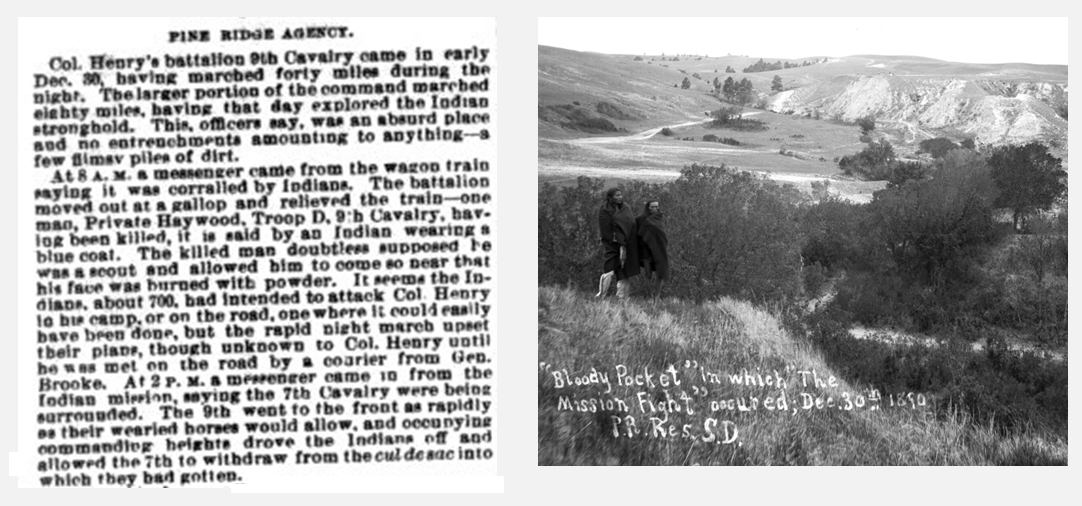
(left) “Pine Ridge Agency.” January 10, 1891. The United States Army and Navy Journal and Gazette of the Regular and Volunteer Forces. p. 338.
(right) Morledge, C. G. Bloody Pocket in which "The Mission Fight" occured [sic]; Dec. 30th 1890, P. R. Res. S.D. Image from Denver Public Library Special Collections, X-31341.
The Wounded Knee massacre undid the work the army had put in to stabilize the situation that their arrival in South Dakota had destabilized. Some groups of warriors went on the attack against the army, including those who attacked the 9th and 7th Cavalry, but most of the Lakota people who had returned to Pine Ridge simply fled once again after learning that the army was firing on women and children. Over the next two weeks, Major General Nelson Miles, the overall commander of the campaign, was able to negotiate with Lakota leaders for their return to the reservation, offering general leniency while also threatening to bring in even more soldiers. By the end of January 1891, the army’s Pine Ridge campaign was over (Richardson 2010).
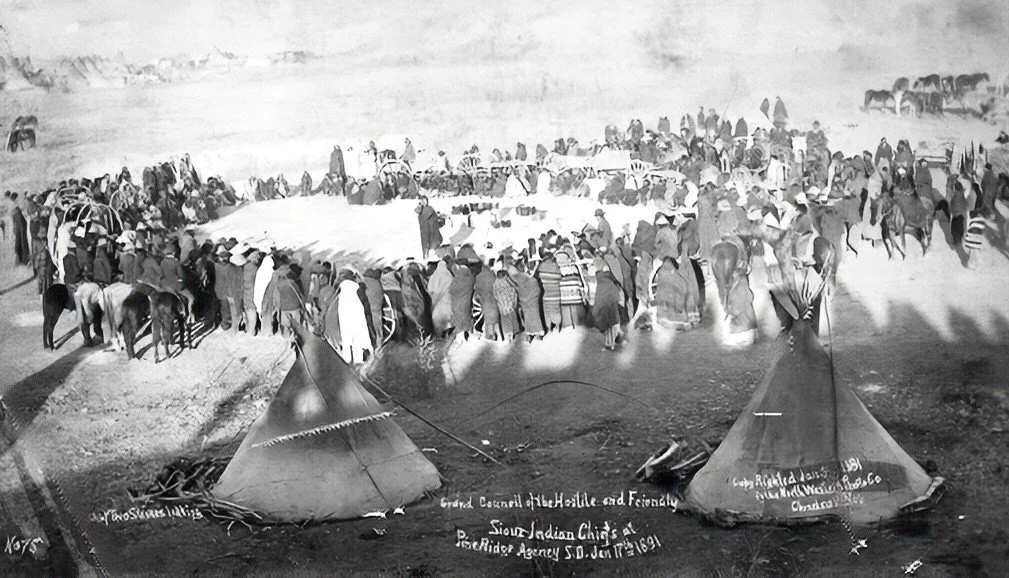
Grand Council of the Hostile and Friendly Sioux Chiefs at Pine Ridge Agency, S.D. Jan 17th 1891. Chadron, NV: Northwestern Photo Company. Image from Denver Public Library Special Collections, X-31289.
A crucial question remains as to why the army would send 3,500 soldiers to stop a religious ritual. Contemporaneous accounts make clear that there was little, if any, evidence of an actual uprising. Similarly, there was little concern about the Ghost Dance on the part of anyone other than Royer and a few other Indian agents, who felt that the dancers were disruptive to order on the reservations. It seems very plausible that the situation could have been resolved through negotiation or even by replacing the Indian agents with more experienced people, such as army officers who had spent time among the Lakota people (Ostler 1996; Richardson 2010).
The sad truth is that the motivations behind this military campaign were political. 1890 was a mid-term election year, and the Republican party was desperate to maintain its hold on Congress. The Republicans had lost the presidency in 1884, for the first time since the Civil War, and Benjamin Harrison had regained it in 1888 by winning the Electoral College but not the popular vote. Leading up to the 1890 election, congressional Republicans rushed to bring new Western states, including South Dakota, into the union, assuming that voters in these states would support the party, but that plan did not turn out as expected. Many voters objected to the Republicans’ support of monopolies and tariffs that raised the price of consumer goods and enriched only a few elite businessmen. In November 1890, the Republicans lost the House of Representatives, and support for continued tariffs in the Senate depended on the election of a Republican in South Dakota. After an election marred by overt fraud, the Republicans in South Dakota seemed to have lost the state legislature, making it less likely that a Republic Senator would be chosen (Richardson 2010). [1]
Under those circumstances, bringing in the army may have seemed like a good idea. What could go wrong? Army mobilizations were popular with American citizens. They made people feel safe and boosted local economies, a real benefit to rural areas like the white settlements in South Dakota. However, while Harrison’s administration ordered the army to resolve the problems in South Dakota, such as they were, it was Gen. Miles who chose to send such a large number of soldiers. His motive seems to have been to prove that the army was still crucial to national security and was far better positioned to manage Indian matters than civilians appointed by the Bureau of Indian Affairs, a long-standing argument for him. Certainly, the letters Miles sent to Washington, DC, justifying the continued military build-up describe a situation that bears little resemblance to most reports from soldiers in South Dakota at the time. As it turns out, of course, quite a bit went wrong, and no one got what they wanted. The Bureau of Indian Affairs remained in control of the reservations, the next Senator from South Dakota was James H. Kyle, an independent reformer, and Harrison lost the presidency to Democrat Grover Cleveland in 1892. In the meantime, Lakota people and U.S. army soldiers suffered through a South Dakota winter, hungry and in a constant state of unease (Ostler 1996; Richardson 2010).
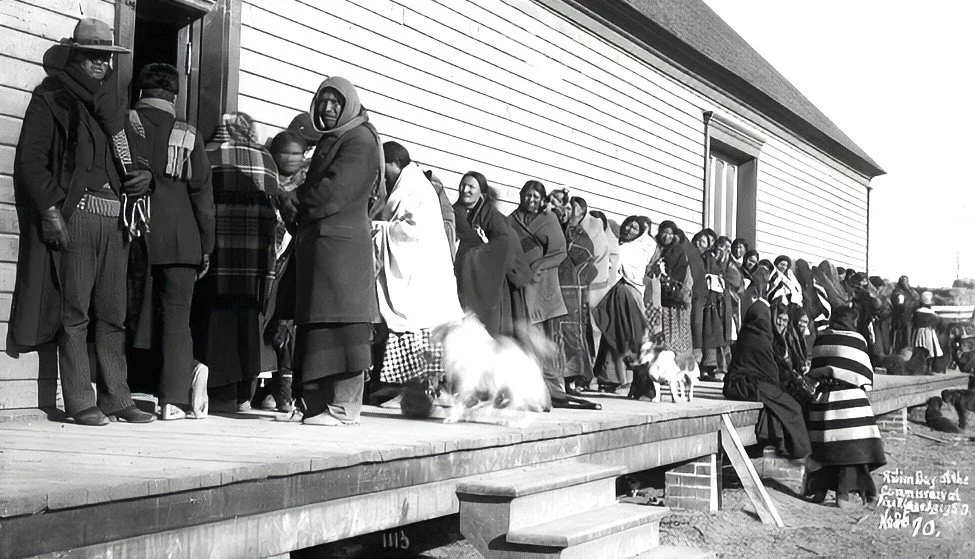
Morledge, C. G. 1890-1. Ration Day at the Commissary at the Pine Ridge Acgy S.D. Image from Denver Public Library Special Collections, X-31445.
It’s hard to accept that the lives lost in the Pine Ridge campaign, both those of Lakota people and of soldiers, were sacrificed in an unsuccessful attempt to bolster political power, but that’s all too often the case. And I do think my great-great-grandfather had some sense of the futility of what he was being asked to do. In a letter to his daughter, written on January 7, 1891, he told her of the death of his friend Cpt. George D. Wallace of the 7th Cavalry, who was killed at Wounded Knee. He went on to say, “[B]ut such is a soldier's life—and what our noble govt pays us for in this inglorious Indian war—carried on by the policy—first to starve the poor Indian—then pump him full of lead” (Erisman & Erisman 1996, p.39).
[1] Prior to 1913, U.S. Senators were chosen by state legislators rather than directly elected by voters.
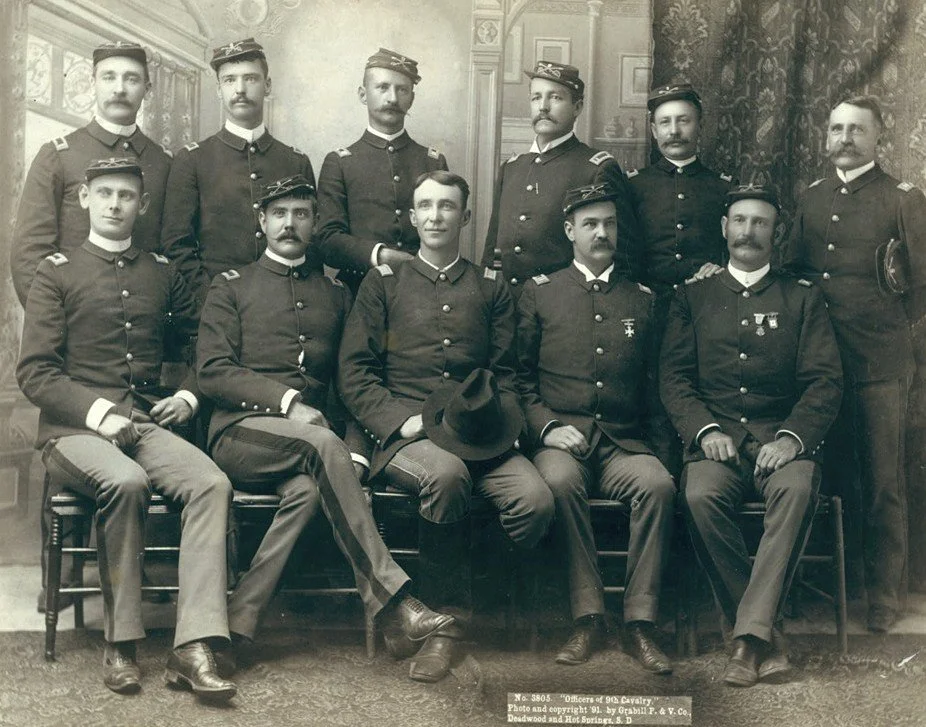

Grabill, J. C. H.1891. Officers of the 9th Cavalry. South Dakota, 1891. Image from the Library of Congress. At right in the back row are Cpt. John S. Loud and Major Guy V. Henry.
Works Cited
Erisman, Fred, and Patricia L. Erisman. 1996. “Letters from the Field: John Sylvanus Loud and the Pine Ridge Campaign of 1890-1891.” South Dakota History 26 (1): 24-45.
Greene, Jerome A. 2014. “On the Brink: The Pre-Wounded Knee Army Deployment of 1890.” Nebraska History 95: 52-63.
Ostler, Jeffrey. 1996. “Conquest and the State: Why the United States Employed Massive Military Force to Suppress the Lakota Ghost Dance.” Pacific Historical Review 65 (2): 217-48.
Richardson, Heather Cox. 2010. Wounded Knee: Party Politics and the Road to an American Massacre. New York: Basic Books.