
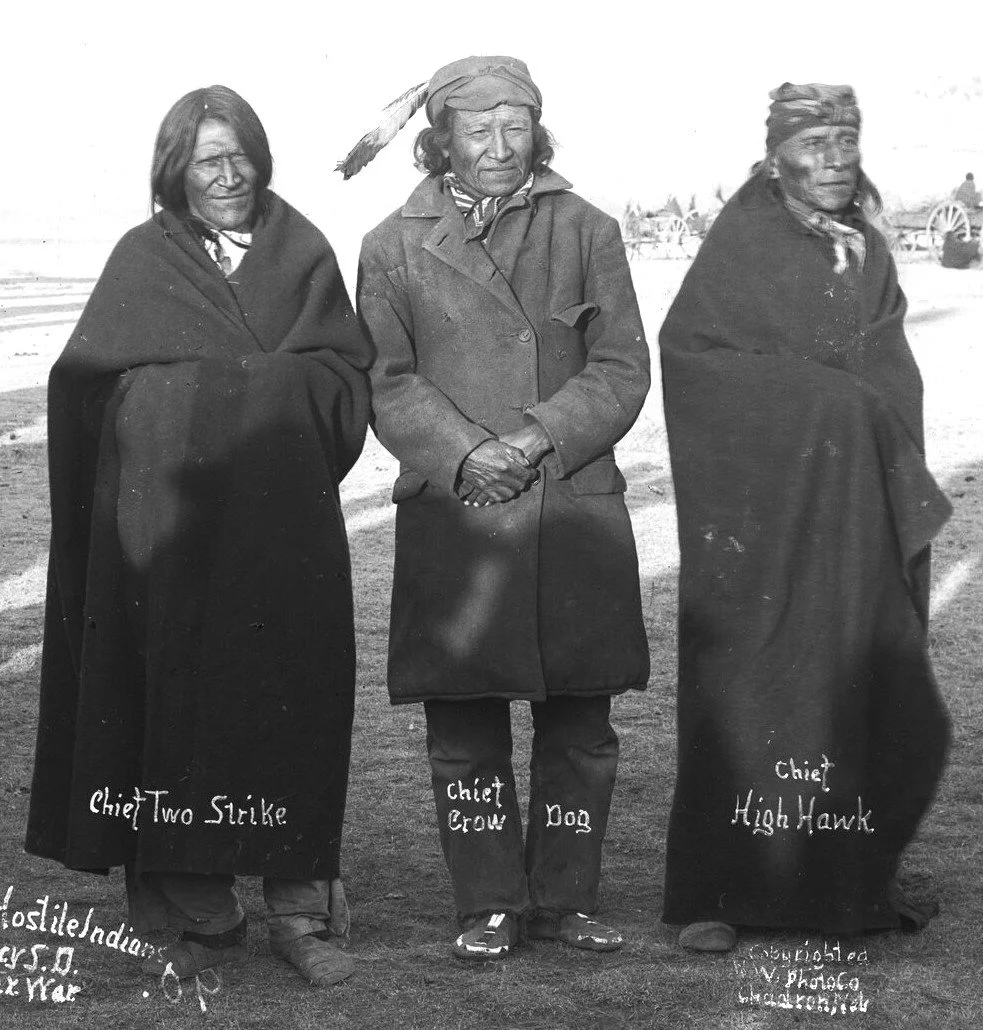
This Inglorious Indian War
On November 17, 1890, Major Guy V. Henry of the 9th Cavalry, commander of Ft. McKinney, Wyoming, received a telegram ordering him to the Pine Ridge Reservation in South Dakota. Two days later, Henry and D Troop of the 9th Cavalry, commanded by my great-great-grandfather Cpt. John S. Loud, set off on the roughly 300-mile journey to the lands of the Lakota people. The 9th Cavalry’s D Troop were not the only soldiers ordered to proceed to South Dakota at that time.

The Last of the Post Traders
Several of the photographs in the Loud family scrapbook that covers their years at Ft. Washakie, Wyoming, depict James K. Moore, the long-time post trader. Moore had come to the West as a young man and worked in various mercantile operations. He became the post trader for Ft. Washakie (then called Camp Auger) in 1871, before the actual fort was built, and he remained there until 1907, only two years before the fort was decommissioned.

The Long Road to Independence
A small, brown paper bag filled with mostly unlabeled, curling photos revealed history that I had never learned about in school. My grandfather, Louis A. Hoch, was a career U.S. Army officer. I knew that he had been stationed in the Philippines for a short time, but I knew nothing else about that period in his life.

Declaring Independence
I was recently in Boston, Massachusetts, where I visited the Old State House, built in 1711 to hold the offices of the colonial governor and council. There I learned that the Declaration of Independence was read from the building’s balcony on July 18, 1776. The task of reading the Declaration fell to William Greenleaf, the sheriff of Suffolk County and my third cousin eight times removed. Unfortunately, William’s voice was quite weak so he was obliged to recruit the help of Thomas Crofts, who repeated each line after William read it.