
The Last of the Post Traders

Several of the photographs in the Loud family scrapbook that covers their years at Ft. Washakie, Wyoming, depict James K. Moore, the long-time post trader. Moore had come to the West as a young man and worked in various mercantile operations. He became the post trader for Ft. Washakie (then called Camp Auger) in 1871, before the actual fort was built, and he remained there until 1907, only two years before the fort was decommissioned. During most of this time, he also served as the official trader to the Shoshone and Arapaho people who lived on the Wind River Indian Reservation, where the fort was located (Delo 1998). Learning a little about Moore’s life led me to a more in-depth exploration of how the army has provided for its soldiers across the years.
James K. Moore, post trader. Fort Washakie, WY. 1895-7. Photo from Loud family scrapbook.
The practice of appointing official merchants to sell items an army could or would not provide its soldiers, including materials for letter-writing, toiletries, and most notably, tobacco and alcohol, dates to at least the 16th century. During the American Revolution, each regiment or army post was permitted to select a sutler who had an exclusive contract to provide the soldiers with the goods they desired. These sutlers typically moved from camp to camp along with the regiment and sold their wares on credit, often using unofficial scrip to keep track of what was sold. The soldiers could thus buy goods even when their pay was irregular, which was a common problem, and the sutler could be sure that the army would cover the soldiers’ debts, even to the point of garnishing the soldiers’ pay. In return for the exclusive contract, the sutler paid a fee, which was used to fund regimental entertainment and welfare activities not covered by the War Department (Delo 1998; Scolnick & Packer 1966).
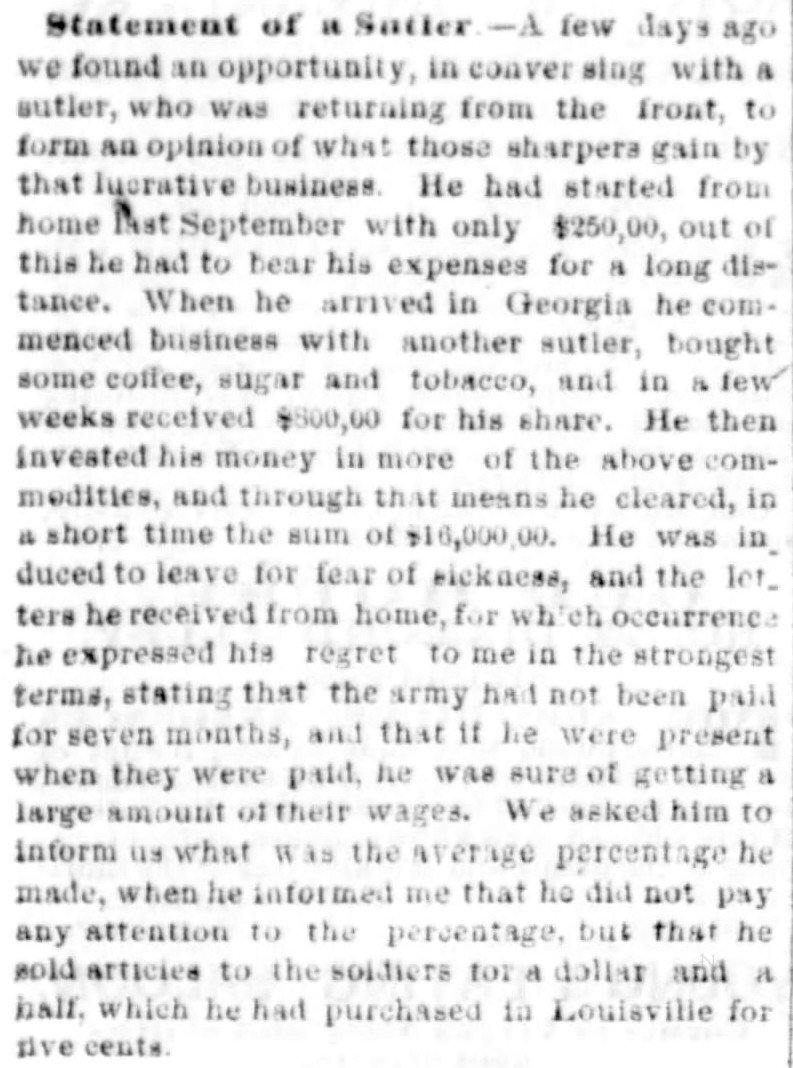
Given the monopolistic nature of sutlers’ contracts, it is unsurprising to learn that there were many abuses of this system. Some sutlers sold poor-quality goods at exorbitant prices. Alcohol, in particular, was a major source of profit for sutlers and could easily be watered down to raise profits. These abuses became especially clear during the Civil War, when the large-scale raising of regiments opened many new opportunities for sutlers, and cronyism led to the appointment of sutlers with little experience and a thirst for profit. Sources from the era indicate that the sutlers’ profit margin was often as much as 50% and that prices were unreasonably high.
“Statement of a Sutler.” July 9, 1864. Pittsburgh Post. P. 3.
Sutlers were even illegally selling postage stamps at rates above face value. After a War Department ban on the sale of alcohol in 1861, sutlers continued to smuggle it into army camps disguised as other items, and they routinely sold cards and dice, despite army regulations against gambling (Delo 1998; Scolnick & Packer 1966; Tapson 1957).
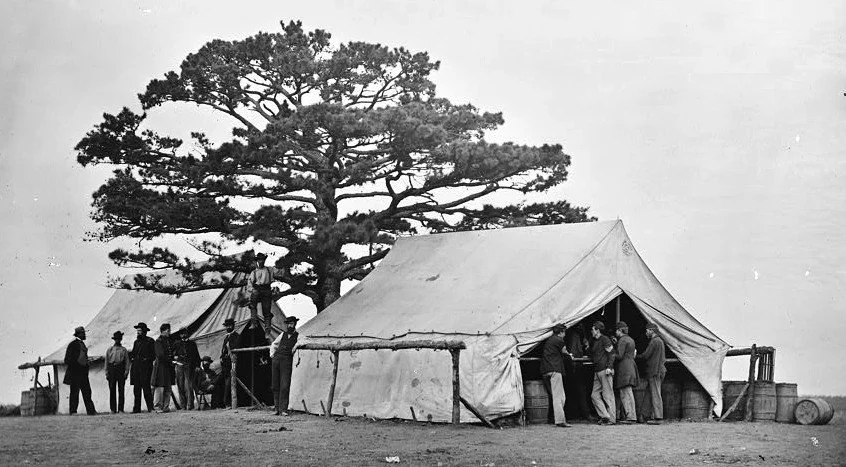
Sutler's tent at the Army of the Potomac headquarters. 1863. Bealeton, VA. Image from the Library of Congress.
In 1866, when the Civil War had ended, Congress took action to end the sutler system, citing reports of corruption and abuse. Initially, the intention was to have the army provide for all soldiers’ needs, with goods sourced through the subsistence department and sold to troops at cost. It quickly became clear, however, that this idea was unworkable. Congress did not appropriate sufficient funds to invest in the purchase of goods beyond essentials, and the far-flung network of posts on the western frontier made it very difficult to obtain and transport even those items (Delo 1998; Scolnick & Packer 1966).
Congress had already provided for the establishment of trading posts at frontier posts, intended to serve travelers and civilian employees, but these traders were not permitted to sell to soldiers. In 1867, that law was changed to allow post traders to sell items not stocked by the commissary. Initially, Congress forbade any monopolistic contracts, but by 1870, the army had returned to what was essentially the sutler system, albeit only at frontier posts. The abuses associated with the sutler system quickly reappeared. In particular, the financial value of an exclusive contract to sell goods at a frontier post made the awarding of such contacts subject to much political maneuvering. In 1876, Secretary of War William Belknap, who had overseen the return to a system of exclusive contracts, resigned from office shortly before being impeached by Congress for accepting bribes in return for post trader contracts (Delo 1998; Scolnick & Packer 1966).
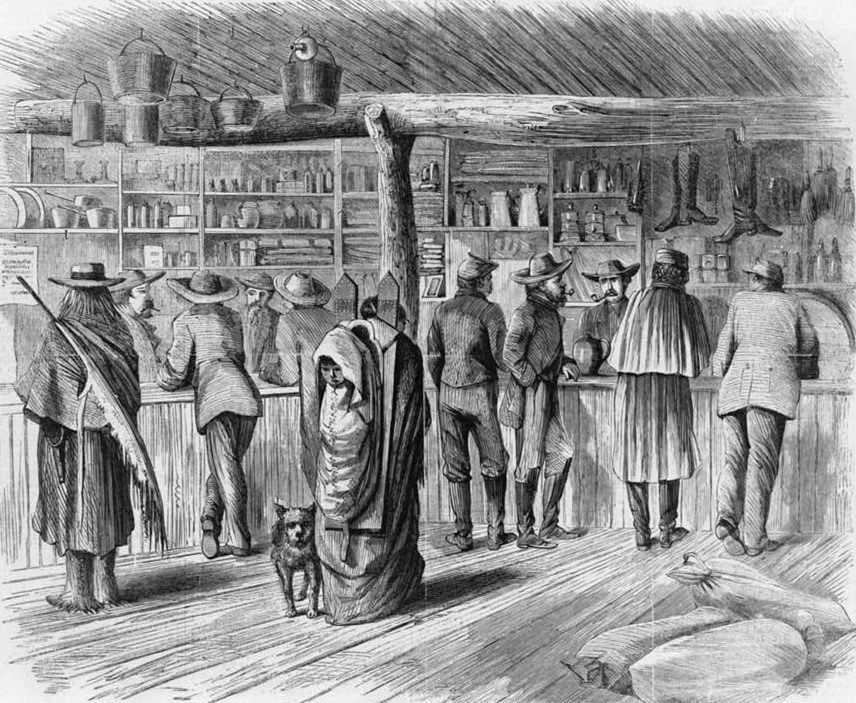
Davis, Theodore R. 1867. Sutler's store at Fort Dodge, KS. Image from the Library of Congress.
The army now had two different systems for supplying soldiers with goods, neither of them very satisfactory. Frontier posts had a post trader, but soldiers were subject to price gouging and poor-quality wares. At posts near larger settlements, soldiers could go into town off-duty and patronize whatever establishment they chose. All too often, they chose to visit saloons and returned to their post drunk, which led to many arrests for disorderly conduct.
Army officers, eager to keep their men entertained on the post, borrowed an idea from the British army and began to establish canteens (Steward 1892). As a War Department report on the canteens explained:
The purpose of canteens is to supply to the troops at reasonable rates light wines, malt liquors, plain lunches, and other commodities, besides furnishing them the facilities for billiards, ten-pins, dominoes, and other games. Canteens are virtually managed on the co-operative principle, i.e., the enlisted men, who are the consumers, carry on the business through one or more officers appointed by the post commander, and the profits, which are intended to be moderate, are ultimately expended for their benefit (U.S. Congress 1891, p. 17).
The earliest known U.S Army canteen was established at Vancouver Barracks, Washington, in 1880 and the practice spread rapidly (Steward 1892).
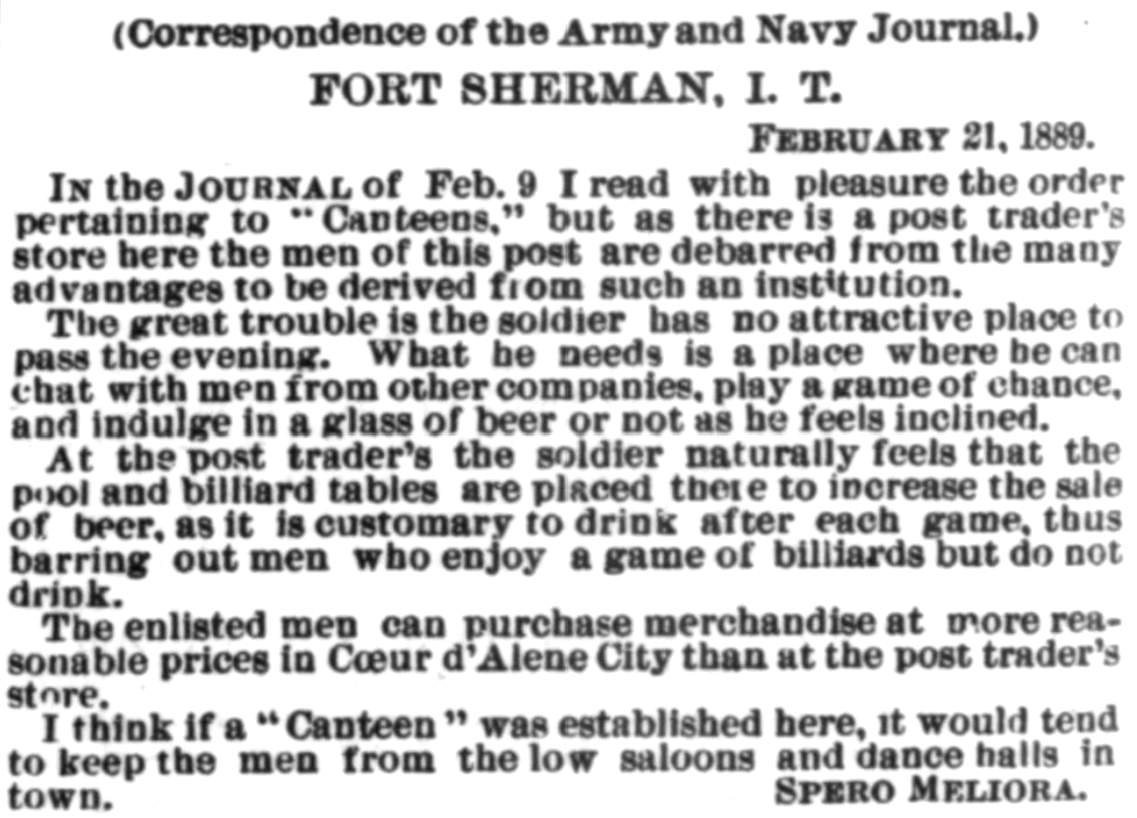
The canteens were a rousing success with enlisted men and officers alike. The War Department report cited above quoted enthusiastic responses from post commanders, including one who said, “In my opinion no step has been taken for the improvement of the moral, social, and intellectual condition of the enlisted men more efficacious than the establishment of the canteen” (U.S. Congress 1891, p. 32).
Meliora, Spiro. March 9, 1889. “Fort Sherman, I.T.” The United States Army and Navy Journal and Gazette of the Regular and Volunteer Forces. p. 552.
Recognizing their value, in 1889, the War Department authorized the establishment of canteens at any army post that did not have a post trader and, less than a year later, amended that order to allow canteens on any post. In 1893, Congress eliminated the position of post trader completely, turning over all responsibility for supplying the off-duty needs of soldiers to the now re-named post exchanges (Delo 1998; Scolnick & Packer 1966). By 1894, the only remaining post traders were James K. Moore at Ft. Washakie and the trader at Ft. Duchesne, Utah, the two most inaccessible army posts in the country, and these forts also had post exchanges (U.S. War Department 1894).
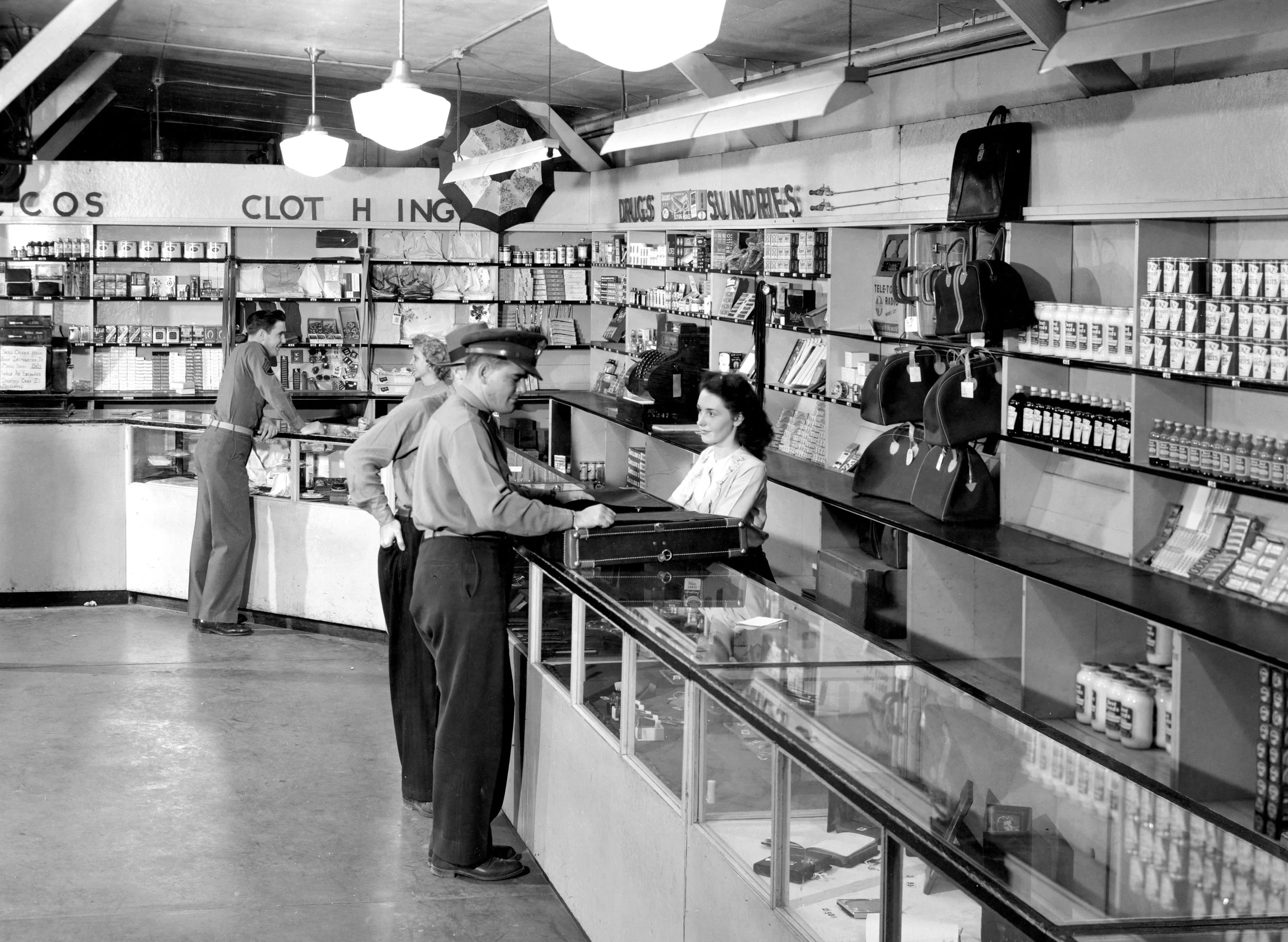
The name change from canteen to post exchange reveals the biggest challenge associated with these operations, the provision of alcoholic beverages. In 1891, the Secretary of War changed the name to remove connotation of a canteen as “a place of conviviality and dissipation” (U.S. War Department 1892, p. 57). At that time, the question of whether or not to serve alcohol was being hotly debated. Some officers believed that offering wine and beer on the post reduced the consumption of hard liquor and pointed to statistics on reduced fighting and arrests among their men. Other, more temperance-minded, officers argued that offering any alcohol encouraged soldiers to drink. As Major General Oliver O. Howard, a strong proponent of this latter position, noted, “The impression is irresistible that here beer is easily and cheaply procured, so that it is constantly forced upon the attention of the enlisted man. He is indeed always tempted to indulge in its use” (U.S. War Department 1892, p. 95). In 1901, Congress banned the sale of alcohol on army posts, a prohibition that continued until 1933 and is thought to have contributed to a shift in post exchanges from a social club to something more like a general store, although modern post exchanges do offer food, drink, and entertainment as well as merchandise (Scolnick & Packer 1966).

(left) Dunn, R.L, January 12, 1901. The Army canteen as it really is—The reading-room at the Bedloe's Island canteen, New York Harbor. New York, NY: Frank Leslie's Illustrated Newspaper. P. 36. Image from Wikimedia Commons.
(right) Army Post Exchange Interior. 1945. Oak Ridge, TN: U.S. Department of Energy, Oak Ridge Office of Environmental Management.
Post traders, like their predecessor sutlers, don’t appear in a very good light in this history. The many instances where they valued profit over the welfare of the troops, as well as the examples of corruption described above, make them seem an unsavory group. That image, however, does not hold true for James K. Moore. In his 35 plus years serving as post trader, Indian trader, postmaster, hotel keeper, and cattle rancher at Ft. Washakie, he and his family seem to have been a stabilizing influence in a very remote area of the West. David M. Delo, in his book on sutlers and post traders, describes Moore as “one of the most ethical, diligent, and sensitive military post traders in America” (Delo 1998, p. 192). It is perhaps fitting that he was the last of the traders that served the army during the 19th century.
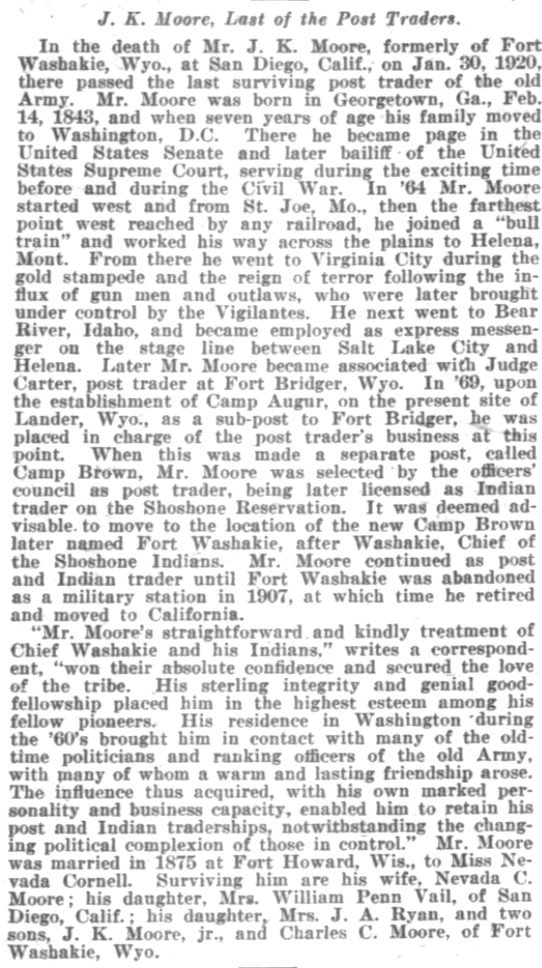

“J.K. Moore, Last of the Post Traders.” March 6, 1920. The United States Army and Navy Journal and Gazette of the Regular and Volunteer Forces. p. 819.
Works Cited
Delo, David M. 1998. Peddlers and Post Traders: The Army Sutler on the Frontier. Helena, MT: Kingfisher Books.
Scolnick, Meyer, and Joseph L. Packer. 1966. "Evolution of the Army and Air Force Exchange Service." United States Air Force JAG Law Review 8 (5): 19-36.
Steward, Theophilus G. April 9, 1892. “The Canteen in the Army.” Harper's Weekly 36 (1842). PP. 350-1.
Tapson, Alfred J. 1957. “The Sutler and the Soldier.” Military Affairs 21 (4): 175-81.
U.S. Congress. House. Committee on Military Affairs. 1891. “Appendix C.” Report on Army Appropriations. H.R. Rep. No. 51-529. 51st Congress, 1st session. Serial 2808.
U.S. War Department. 1892. Report of the Secretary of War. Vol 1. Washington, DC: U.S. Government Printing Office.
U.S. War Department. 1894. Annual Report of the Secretary of War for the Year 1894. Vol 1. Washington, DC: U.S. Government Printing Office.