
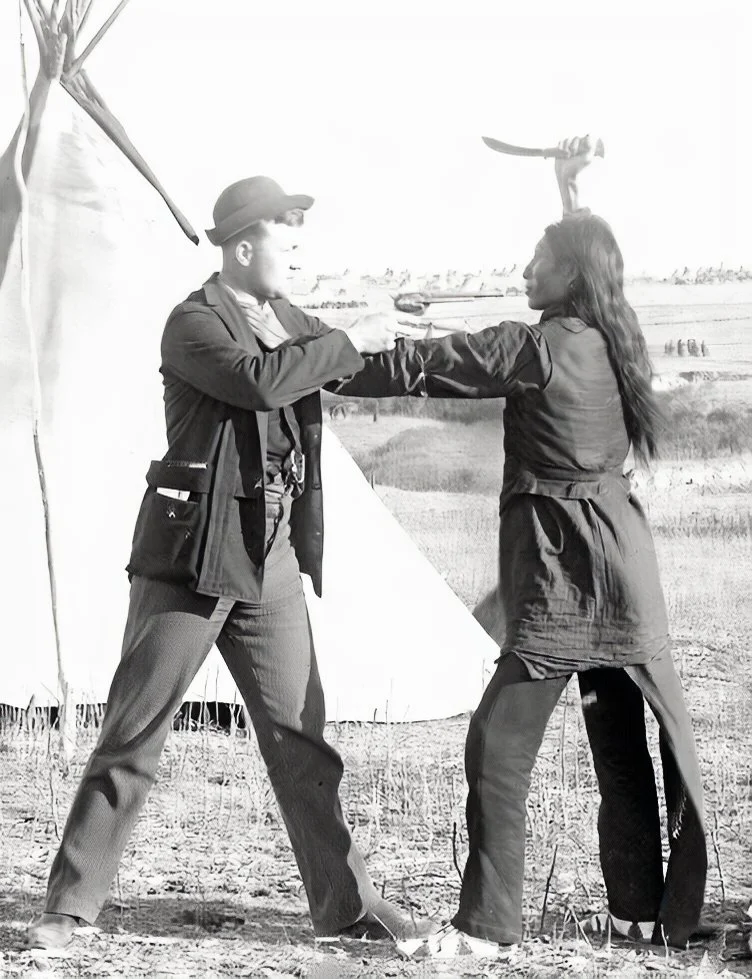
When my great-great-grandfather, Cpt. John S. Loud of the 9th Cavalry, was serving in the army’s Pine Ridge campaign in late 1890, he wrote to his wife to let her know that his regiment had been involved in two skirmishes but that he was unscathed. In the margin of that letter, dated December 30, 1890, he wrote, “Do not believe any news-paper reports—All are exaggerated" (Erisman & Erisman 1996). This simple bit of marginalia highlights one of the key factors that influenced public perceptions of this campaign—the extensive newspaper coverage that accompanied it.
Morledge, C. G. 1890. Staged photo of C. H. Cressey, correspondent for the Omaha Bee, fighting with a Lakota man. Pine Ridge Reservation, SD. Image from Denver Public Library Special Collections, X-31441.
As I have discussed in a previous post, the Pine Ridge campaign had its roots in various efforts to preserve Republican political power and reestablish military control over the Indian reservations, but the precipitating factor was the Ghost Dance movement on the Lakota reservations in South Dakota in the fall of 1890 (Richardson 2010). The Ghost Dance movement started in Nevada with a Northern Paiute spiritual leader named Wovoka. Perceived by many Native Americans as a new Messiah, Wovoka taught that, if the Ghost Dance was performed properly by enough people, all white people would vanish and the native peoples could return to their traditional lives, free from the disease and misery that had had been brought to them by white settlers. The Ghost Dance spread rapidly across the American West during 1889 and 1890 and was modified as different groups adopted the practice. Among the Lakota people, dancers believed that a great catastrophe would come to wipe out white settlers and that the “ghost shirts” they wore in the dance could not be pierced by weapons (Mooney 1893).
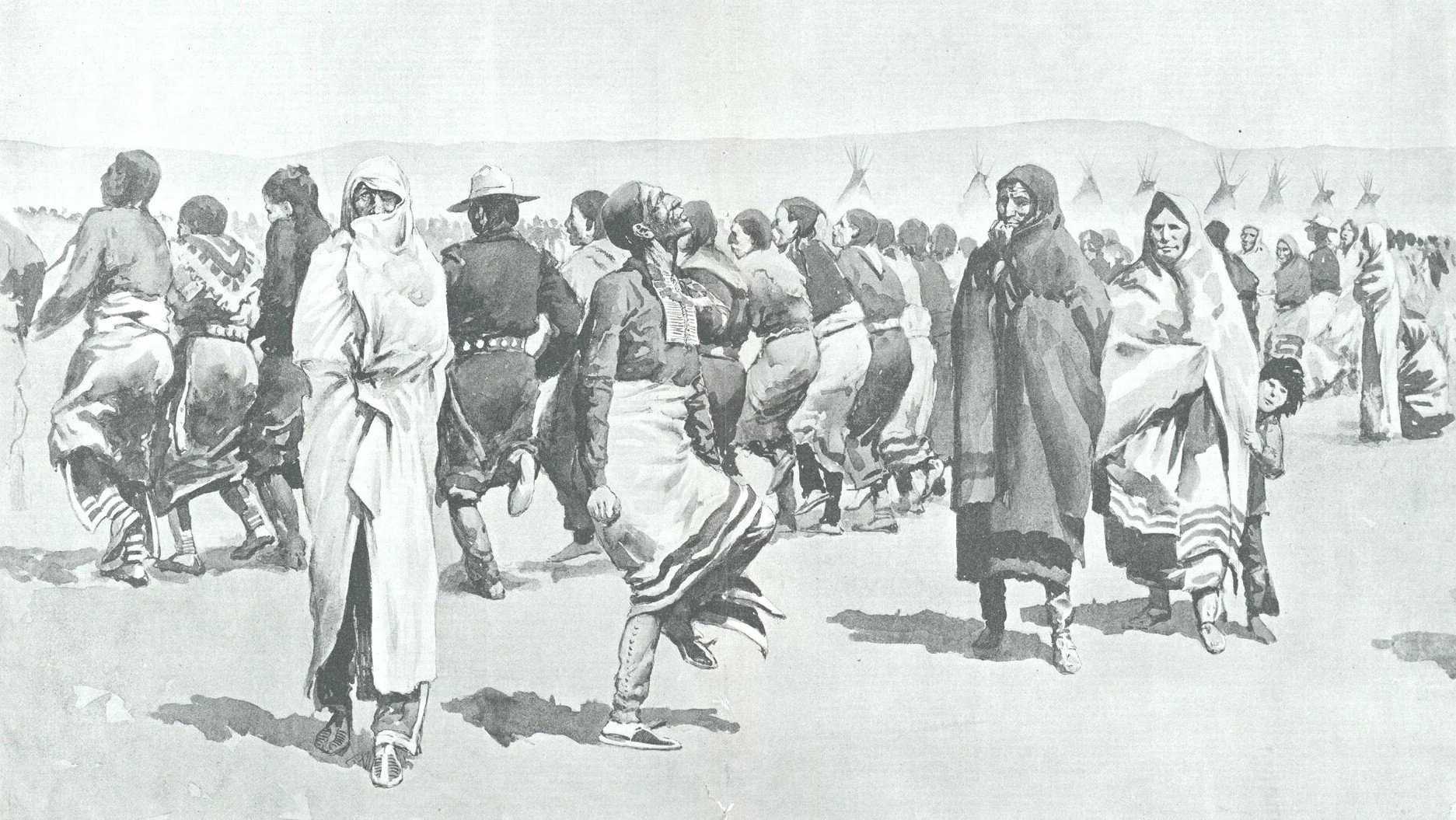
Remington, Frederic. December 6, 1890. The Ghost Dance by the Ogallala [sic] Sioux at Pine Ridge Agency Dakota. Harper's Weekly 34 (1772): 960-1. Image from the Library of Congress. Western artist Remington was at Pine Ridge as a correspondent for Harper’s Weekly.
The Ghost Dance movement was unsettling to white Americans who learned of it, disturbing in its vision of a world without white people, its dissimilarity to sedate Christian religious practices, and the speed and intensity with which it spread. Many white Americans of that era had come to believe that only conquest and assimilation would quell the threat of Indian hostilities that had plagued them since the early days of European settlement in North America, and some still believed the axiom that the only good Indian was a dead one. Even so, for much of 1890, most white Americans knew little about the Ghost Dance and cared even less (Richardson 2010).
That situation changed when U.S. army troops were sent into South Dakota in November 1890 to put down the Ghost Dance movement and prevent the hostilities that might allegedly arise from it. The army’s arrival caused panic among the Ghost Dancers, who fled their reservations for fear they would be killed or imprisoned. The numbers fleeing increased after December 15 when renowned Hunkpapa Lakota leader Sitting Bull, the man whose leadership had inspired the defeat of Gen. George Custer at Little Big Horn in 1876, was killed by Indian police as they tried to arrest him on the Standing Rock Reservation. The allegations of Lakota hostilities became a self-fulfilling prophecy as groups of armed Lakota warriors holed up in remote locations around the state, intent on protecting themselves and their families and defending their religious practices (Richardson 2010).
Despite the panic, there was little armed conflict during the first six weeks that the army occupied the Lakota reservations. In fact, many of the Ghost Dancers agreed to come back to the reservations peacefully. You wouldn’t have known this, though, if you read the newspaper accounts that were published across the nation. As soon as the army began its campaign, newspapers in the Midwest, and some national papers, sent reporters to South Dakota, hoping to use stories of Indian battles to sell papers. This era was one during which the number of newspapers in the United States increased dramatically, and publishers were eager to attract new readers. As there weren’t any actual battles to report, many of the reporters onsite wrote about wild rumors and minor incidents. These stories were then repeated in newspapers across the country via the Associated Press (Kolbenschlag 1980; Abourezk 2012).
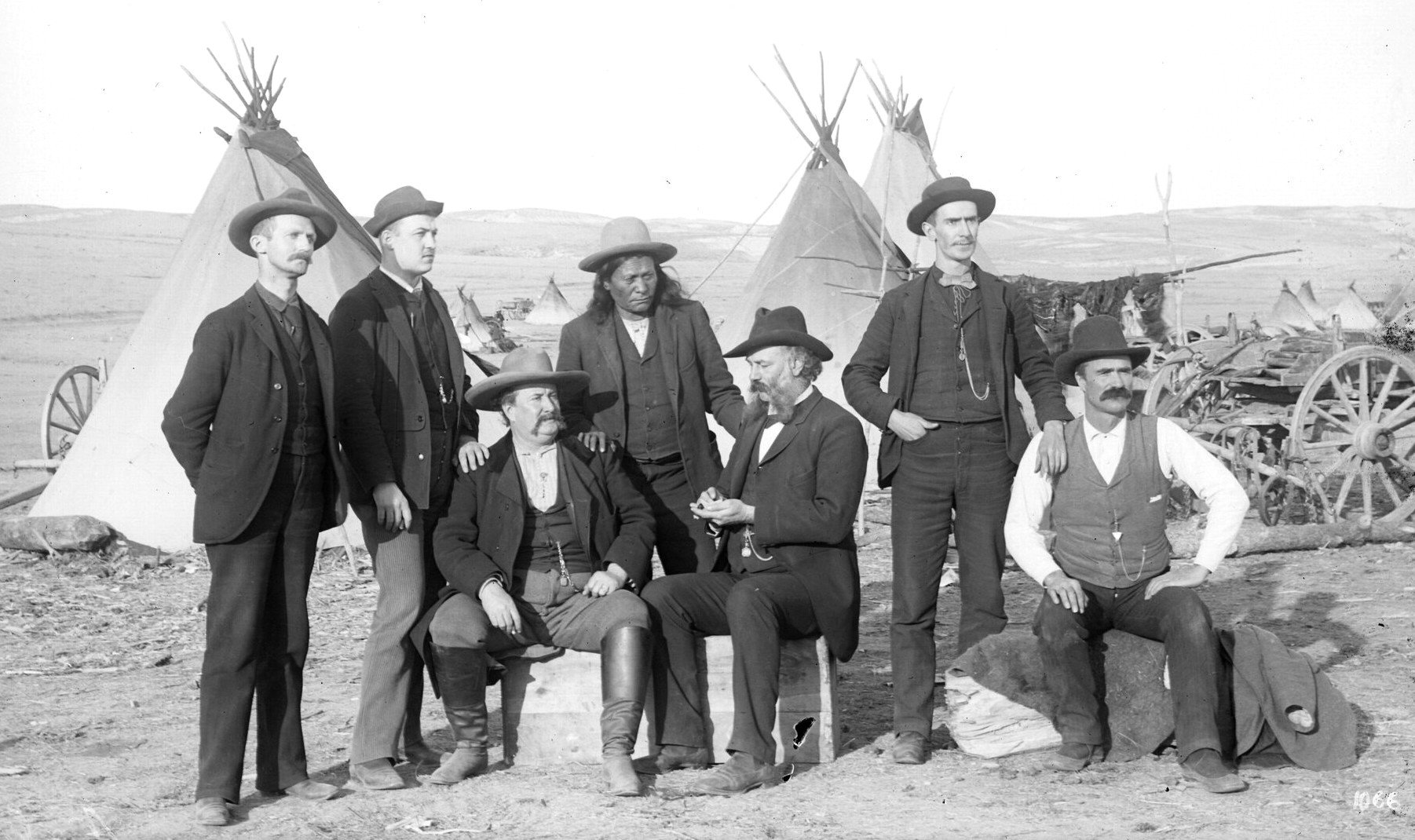
Morledge, C. G. 1890. A group of reporters and others pose in a Sioux camp. Pine Ridge Reservation, SD. Image from Denver Public Library Special Collections, X-31438. Left to right: C. H. Cressey, Omaha Bee; William F. Kelley, Nebraska State Journal; Major John Burke, general manager of Buffalo Bill's Wild West show; unidentified Native American man; Alfred Burkholder, New York Herald; unidentified reporter; and Charles W. Allen, Chadron Democrat.
Newspaper stories about the Pine Ridge campaign were often highly sensationalized. “Fanaticism Nearing to Bloodshed,” “The Bad Reds,” “Trouble Imminent,” and “The Ghost Dance: It Must Be Stopped and That Pretty Soon” were all headlines in an uncredited story, published between November 21 and 29 in a dozen or more newspapers across Kansas and Missouri. [1] The American public, reading the papers, believed that the army was on the brink of a terrible war. The Lakota people, too, read the stories and believed that the army was poised to attack them (Kolbenschlag 1980; Abourezk 2012).
Worse still, different newspapers, with different political loyalties, provided competing, and often contradictory, accounts of what was happening in South Dakota (Kolbenschlag 1980; Abourezk 2012). In Omaha, Nebraska, for example, the Daily Bee, which supported the Republicans currently in power, provided regular headlines predicting that fighting was inevitable while the World-Herald, a Democratic paper, offered a somewhat more balanced perspective, often emphasizing that governmental corruption was motivating the Lakota people to action. On November 24, as many Lakota arrived at the Pine Ridge Agency for their regular allocation of beef, the two papers ran front-page articles with the very different headlines shown below. It’s worth noting, however, that the World-Herald’s article went on to report, “Indians have sent word to Pine Ridge that if General Brooke wants to fight he can have all of it he wants, and will need more soldiers.”
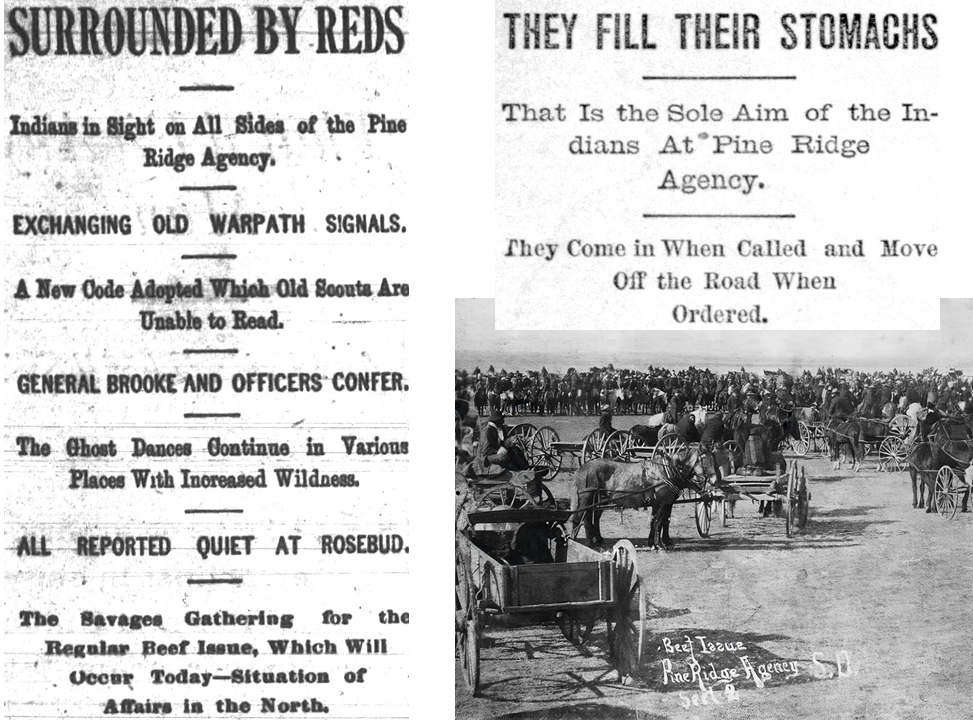
(left) “Surrounded by Reds.” November 24, 1890. Omaha Daily Bee. p. 1.
(right top) “They Fill Their Stomachs.” November 24, 1890. Omaha Evening World Herald. p. 1.
(right bottom) Beef Issue, Pine Ridge Agency S.D., sect 2. 1890-91. Image from Denver Public Library Special Collections, X-31290.
Eventually, the tentative peace in South Dakota was broken. On December 29, eight troops of the 7th Cavalry, the regiment once commanded by Gen. Custer, were guarding the camp of a group of Miniconjou Lakota led by chief Spotted Elk (also known as Big Foot). Col. James W. Forsyth ordered the Lakota to give up their guns, which they were reluctant to do because they relied on their weapons for hunting and defense. Some soldiers then began a search of the camp and the people, while nearly 500 more surrounded the camp with their weapons at ready, including four light artillery guns (Richardson 2010).
A shot was fired by one of the Lakota, probably accidently although accounts vary widely, and the army opened fire. For two hours, they systematically pursued and killed many members of Spotted Elk’s group—including babies, children, women, and old men, like Spotted Elk himself, too ill to rise from their beds. The exact number of Lakota people killed at the Wounded Knee massacre has never been determined but was most likely around 250, including those who died later of their wounds. During the massacre, 25 soldiers were also killed, most by friendly fire when the soldiers surrounding the camp shot into each other’s ranks (Richardson 2010).

Grabill, J. C. H.1891. What's Left of Big Foot's Band. South Dakota Pine Ridge Indian Reservation. Image from the Library of Congress.
Now the newspaper reporters had something to report. The initial descriptions of what happened at Wounded Knee were generally factual, although consistent in placing blame on the Lakota. Three reporters were actually at the scene and witnessed the incident. Quickly, though, the papers returned to their ongoing narratives, decrying the treachery of the Lakota, praising the actions of the 7th Cavalry, and predicting further bloodshed. One notable exception to this trend was the Omaha World-Herald, which had the only Native American and one of only two female reporters present at Pine Ridge, Suzette La Flesche. The World-Herald’s story called the incident a massacre and spoke of the soldiers giving no quarter and killing regardless of age or sex (Kolbenschlag 1980; Abourezk 2012).
In the aftermath of Wounded Knee, Major General Nelson Miles, the overall commander of the Pine Ridge campaign, made it clear that he blamed Col. Forsyth for the debacle, both because he placed his men in a situation where they ended up shooting one another and because he allowed the wholescale slaughter of non-fighters. He removed Forsyth from his command and ordered him brought before a court of inquiry. However, some army officers, many politicians, and the newspaper-reading public disagreed with Miles’s conclusions. They saw the 7th Cavalry’s actions as a heroic defense against a dangerous enemy. Forsyth was largely cleared by the court of inquiry and completely exonerated by the Secretary of War whose report blamed the massacre solely on the Lakota people. Nineteen of the soldiers who participated in the Wounded Knee massacre were awarded the Medal of Honor (Richardson 2010). [2]
Newspapers played a role in this outcome, too, as Forsyth’s officers used the press to tell their version of the story. By January 1891, more details of the incident had come out, and some reporters, particularly from Democratic newspapers, did comment harshly on the deaths of so many women and children. For the most part, though, those reporters also accepted that responsibility for the massacre lay with the Lakota themselves (Richardson 2010). And even the Omaha World-Herald was happy to report that the 7th Cavalry rode next to the caisson when William T. Sherman, former commanding general of the U.S. Army, was buried in St. Louis on in February 1891 (Omaha World-Herald, Sunday, February 22, 12891, p. 1).
[1] See, for example, The Kansas City Gazette, Friday, November 21, 1890, p. 3.
[2] Since 2019, several bills have been introduced into Congress seeking to rescind these medals (Mears 2024). A recent review by the Department of Defense ended with the 2025 decision that the medals would not be rescinded.
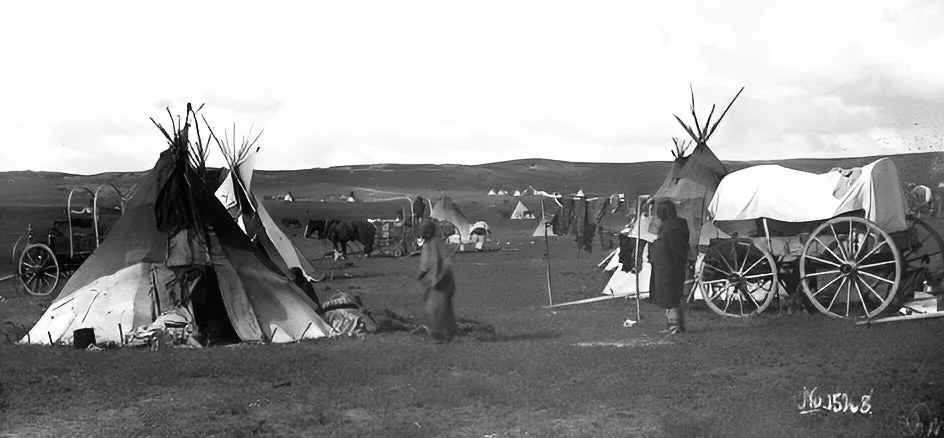
Morledge, C. G. 1891. Lakota Sioux Camp on the Pine Ridge Reservation, South Dakota. Image from Denver Public Library Special Collections, X-31300.
Works Cited
Abourezk, Kevin. 2012. From Red Fears to Red Power: The Story of the Newspaper Coverage of Wounded Knee 1890 and Wounded Knee 1973. Master’s Thesis. Lincoln, NE: University of Nebraska-Lincoln.
Erisman, Fred, and Patricia L. Erisman. 1996. “Letters from the Field: John Sylvanus Loud and the Pine Ridge Campaign of 1890-1891.” South Dakota History 26 (1): 24-45.
Kolbenschlag, George R. 1990. A Whirlwind Passes- News Correspondents and the Sioux Indian Disturbances of 1890-1891. Vermillion, SD: University of South Dakota Press.
Mears, Dwight S. 2024. “Removing the Stain Without Undermining Military Awards: Revoking Medals Earned at Wounded Knee Creek In 1890.” American Indian Law Review 48 (1): 179-216.
Mooney, James. 1893. The Ghost-Dance Religion and the Sioux Outbreak of 1890. Fourteenth Annual Report of the Bureau of Ethnology to the Secretary of the Smithsonian Institution, part 2. Washington, DC: Government Printing Office.
Richardson, Heather Cox. 2010. Wounded Knee: Party Politics and the Road to an American Massacre. New York: Basic Books.