
Declaring Independence
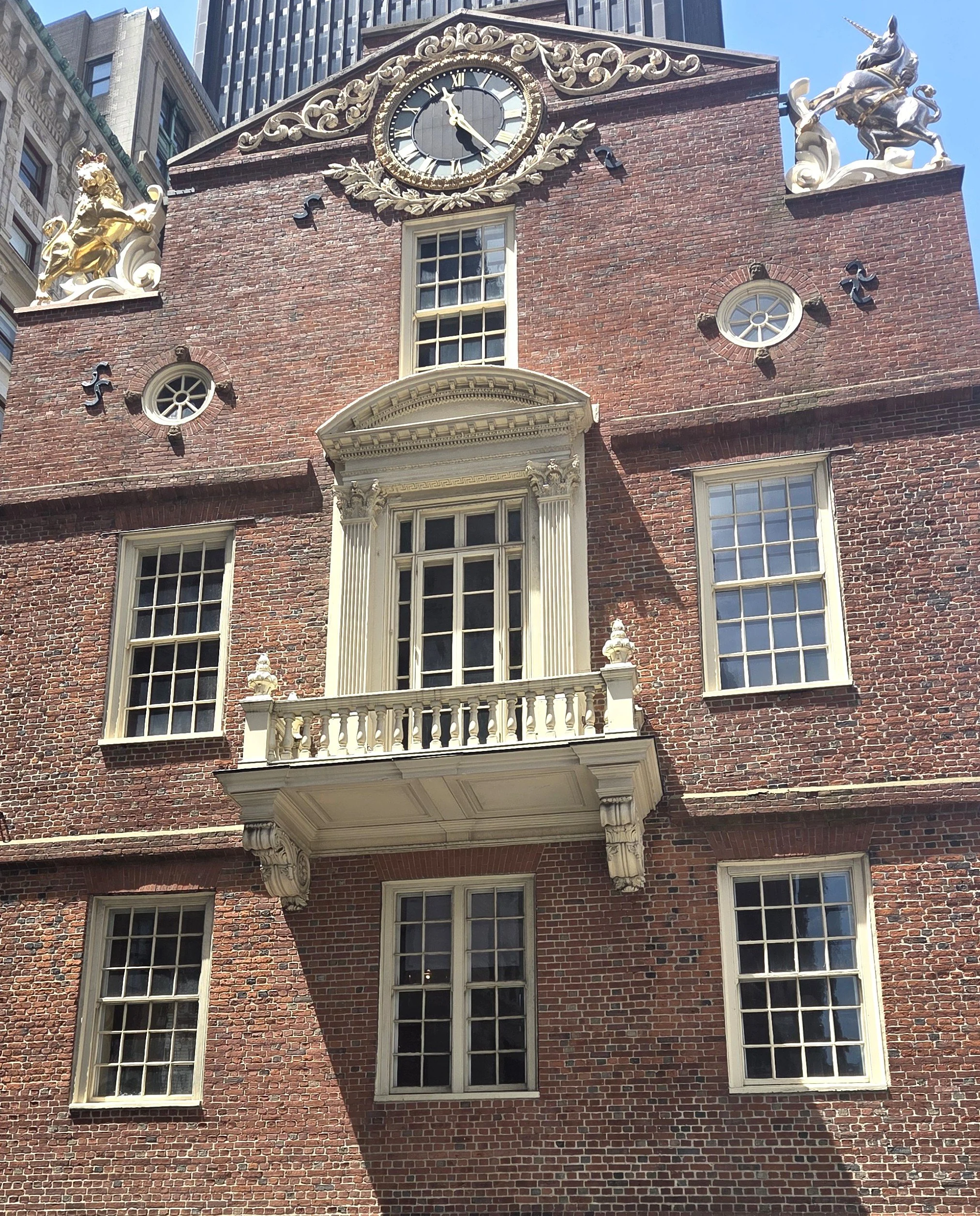
I was recently in Boston, Massachusetts, where I visited the Old State House, built in 1711 to hold the offices of the colonial governor and council. There I learned that the Declaration of Independence was read from the building’s balcony on July 18, 1776. The task of reading the Declaration fell to William Greenleaf, the sheriff of Suffolk County and my third cousin eight times removed. Unfortunately, William’s voice was quite weak so he was obliged to recruit the help of Thomas Crofts, who repeated each line after William read it (Edmonds 1925).
Balcony of the Old State House in Boston, from which the Declaration of Independence wa read in 1776. Photo by author.
It was interesting to learn that a distant cousin was involved in this historic moment, but what most struck me was the realization that the Declaration, once adopted by the Continental Congress, had to be shared throughout the the new United States. In a world with only horses and boats for transportation, that must have taken considerable effort.
Most of us are very aware that the Declaration of Independence was written by Thomas Jefferson and unanimously ratified by the Second Continental Congress in Philadelphia on July 4, 1776. What happened after that is far less well known. We tend to think of July 4 as the day the congressional delegates signed the declaration, but that’s not accurate. The Congress voted to adopt the Declaration on July 4. It was then engrossed—formally written up on parchment—and signed on August 2. It is the engrossed and signed version of the Declaration, with the signature of John Hancock, president of the Congress, boldly at the top, that is now reverently housed at the National Archives. The handwritten version of the Declaration edited and adopted by Congress on July 4 has been lost (Edmonds 1925; Boyd 1976; Sneff 2026).
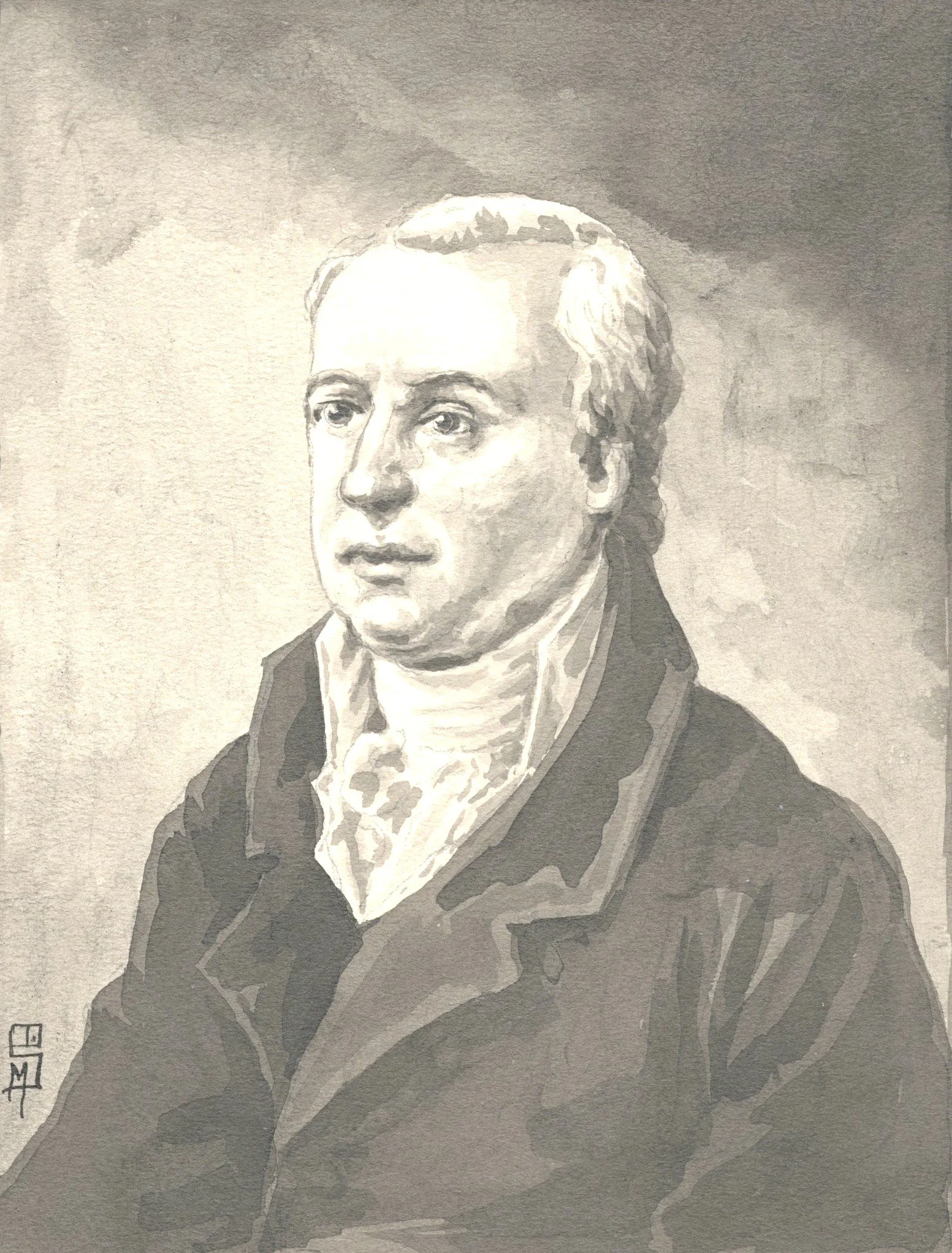
The first action of the Continental Congress after adopting the Declaration was to order that multiple copies be printed. The printer chosen was John Dunlap, an immigrant from Ireland, who ran a newspaper and printing office just a few blocks from Independence Hall, where the Congress was meeting. Dunlap had already done several printing jobs for the Continental Congress and would go on to become its official printer. In July 1776, his task was to set the type for and print several hundred broadside copies of the Declaration of Independence. [1]
Stauffer, David McN. 1885. John Dunlap. First printer of the Declaration of Independence. Image from The Miriam and Ira D. Wallach Division of Art, Prints and Photographs: Print Collection, The New York Public Library.
Dunlap most likely used the handwritten version adopted by the Continental Congress to guide his work. The exact number of copies he printed is unknown, but the 25 remaining originals show that there were at least two print runs and that they were printed in a hurry. Several of the original copies, for example, were folded before the ink was completely dry (Edmonds 1925; Sneff 2026).
Once the Dunlap broadsides were printed, copies were distributed across the new nation. Copies were sent to the governors and legislatures of the various states, committees of safety in major cities, and personal associates of congressional delegates. Copies of the Declaration were sent by John Hancock to General George Washington with orders that it be read to the troops of the Continental Army (Edmonds 1925). These copies were most likely sent by express couriers riding on horseback, which was at the time the fastest, most reliable method, and most secure method of communication. While it might have been faster to send the broadsides to the more southern states by boat, the British navy was a constant threat along the Atlantic coast (Sneff 2026).

As copies of the Declaration arrived in cities and towns across the country, the contents were shared with local residents. As the example of Boston shows, it was common for the Declaration to be read aloud by a local official. The broadside might also be posted in a central location for people to read. In places large enough to have a printer, that person typically printed up additional copies for sale to local residents. In Boston, printers produced copies of the broadside between July 15, when the document arrived in the city, and July 18, when the official reading took place. Printers in Philadelphia, with large populations of German-speaking immigrants nearby also produced copies of the Declaration in German (Sneff 2026).
American Gazette or the Constitutional Journal. July 23, 1776. Salem, Massachusetts. Page 24.
Another mechanism by which the Declaration was disseminated was the newspapers. Newspapers across the country printed the full text of the Declaration, often on the front page, emphasizing its importance in an era where the front page of a newspaper usually contained material that could be typeset in advance (Sneff 2026). The dates of these publications help to show how long it took news of the Declaration to spread. In Philadelphia, for example, the Declaration was published in the Pennsylvania Evening Post on July 6 and in John Dunlap’s Pennsylvania Packet on July 8. In Boston, several newspapers published it on July 18, the day of the official reading, and it appeared in the newspaper on July 20 in Williamsburg, Virginia. It took longer for the Declaration to reach the most southern states. In Charleston, South Carolina, for example, it was August 2 before the Declaration appeared in a newspaper (Edmonds 1925; Declaration Resources Project 2016).
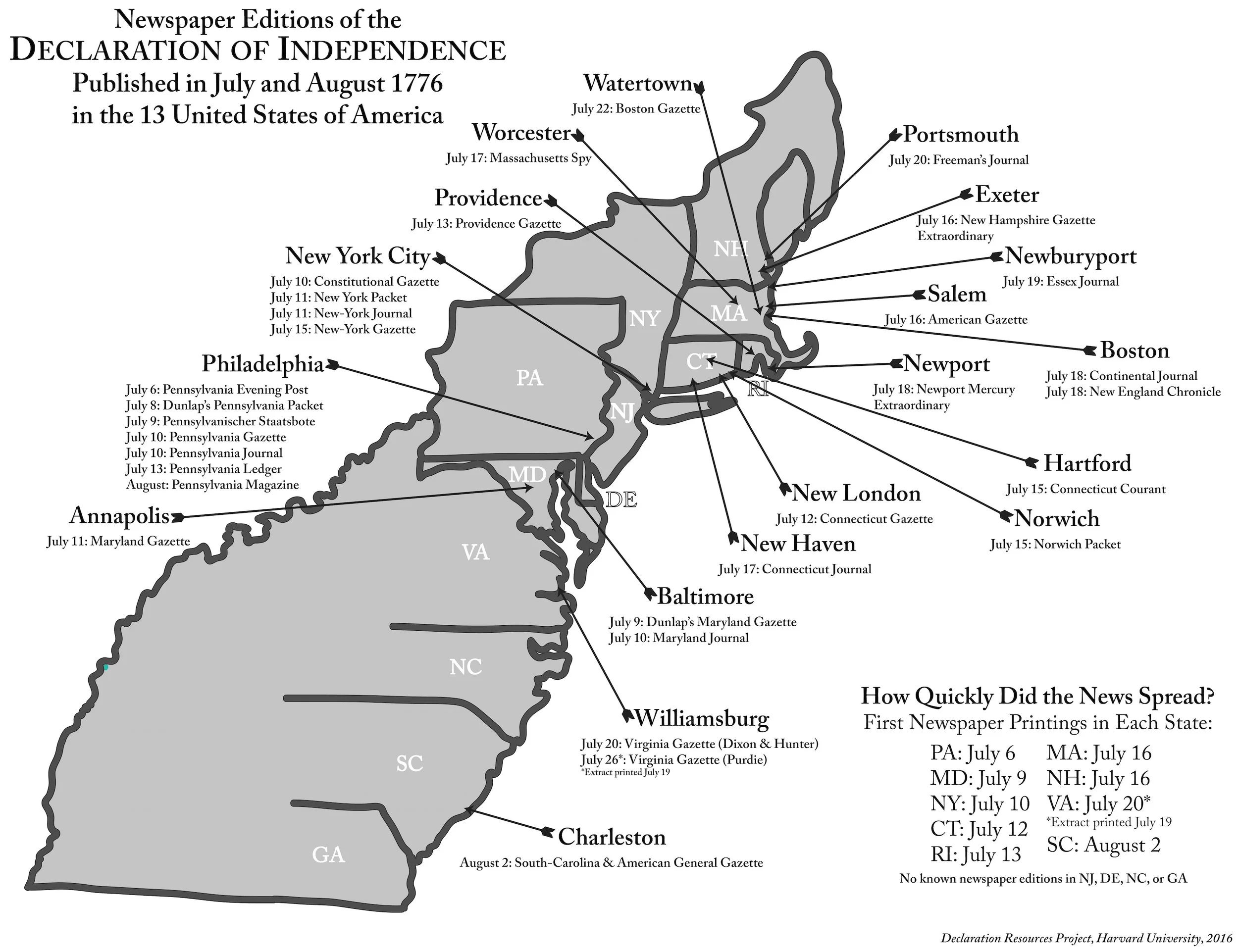
Map showing dissemination of the Declaration of Independence in American newspapers. 2016. Declaration Resources Project. Cambridge, MA: Harvard Graduate School of Education.
Regional and local leaders made plans to ensure news of the Declaration reached all the inhabitants of their regions. In Massachusetts, the legislature ordered a large number of broadside copies, which were sent to the ministers of every parish in the state, with orders to read it to their congregations and then place the copy on file with the town clerk (Edmonds 1925). Even Native Americans were told of the Declaration. In early August 1776, for instance, Philip Schuyler of New York, the future father-in-law of Alexander Hamilton, presented the Declaration to hundreds of indigenous people of the Iroquois Confederacy, as part of an effort to keep them from aiding the British (Sneff 2026).
News of the Declaration of Independence was generally received with delight by the citizens of the new nation. Newspaper accounts, like those pictured below, speak of cheering crowds, church bells ringing, volleys of gunfire, and toasts made in honor of independence. Symbols of the monarchy, such as the lion and the unicorn on the Old State House in Boston (now restored), were torn down and burned. In New York City, a crowd tore apart an enormous statue of King George III. George Washington condemned this action as overly riotous but did not hesitate to have the lead statue melted down to make much-needed ammunition (Edmonds 1925; Sneff 2026).
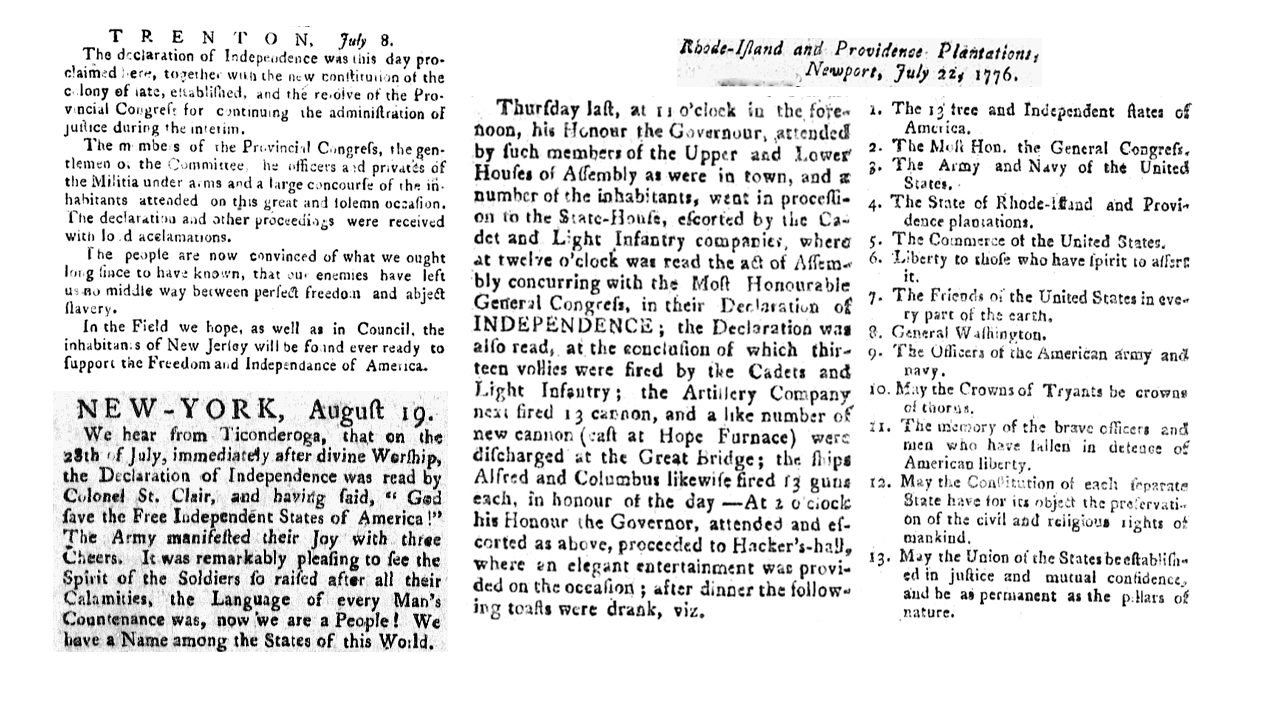
(top left) The New England Chronicle. July 25, 1776. Page 1
(bottom left} The New York Gazette and Weekly Mercury. August 19, 1776. Page 2.
(right) The New York Journal. August 8, 1776. Page 1.
There were, of course, loyalists who condemned the Declaration, but sentiments in favor of independence were running so high that they often feared expressing their opinions in public. The sheriff of Baltimore County, Maryland, left town rather than read the Declaration aloud. Anglican ministers found themselves in a particularly difficult position, given that the King of England was also the head of their church. One Massachusetts minister was even charged with sedition for refusing to read the Declaration to his congregation and for continuing to pray for the king, as the Anglican Book of Common Prayer demanded (Sneff 2026).
In 1776, the Declaration of Independence wasn’t just a symbolic piece of parchment, signed by the Founding Fathers. It was a living document. It was read aloud in public settings, debated in coffeehouses, hung on the walls of public and private buildings, and printed in newspapers. It was translated into different languages, printed with various typographical errors, and sometimes used as scrap paper. [2] I think we might do a better job of living up to its ideals if we made it a living document again. Tomorrow, on the 250th anniversary of its ratification, let us keep in mind what the Declaration meant to the people of the time and to us today.
[1] A broadside is a large sheet of paper printed only on one side. They were a common format in the 18th century and were generally intended to be hung on a wall so that people could read them.
[2] For anyone who would like to learn more about the Declaration of Independence in its time, I highly recommend Emily Sneff’s new book, When the Declaration of Independence Was News. She does a great job of bringing the world of 1776 to life.
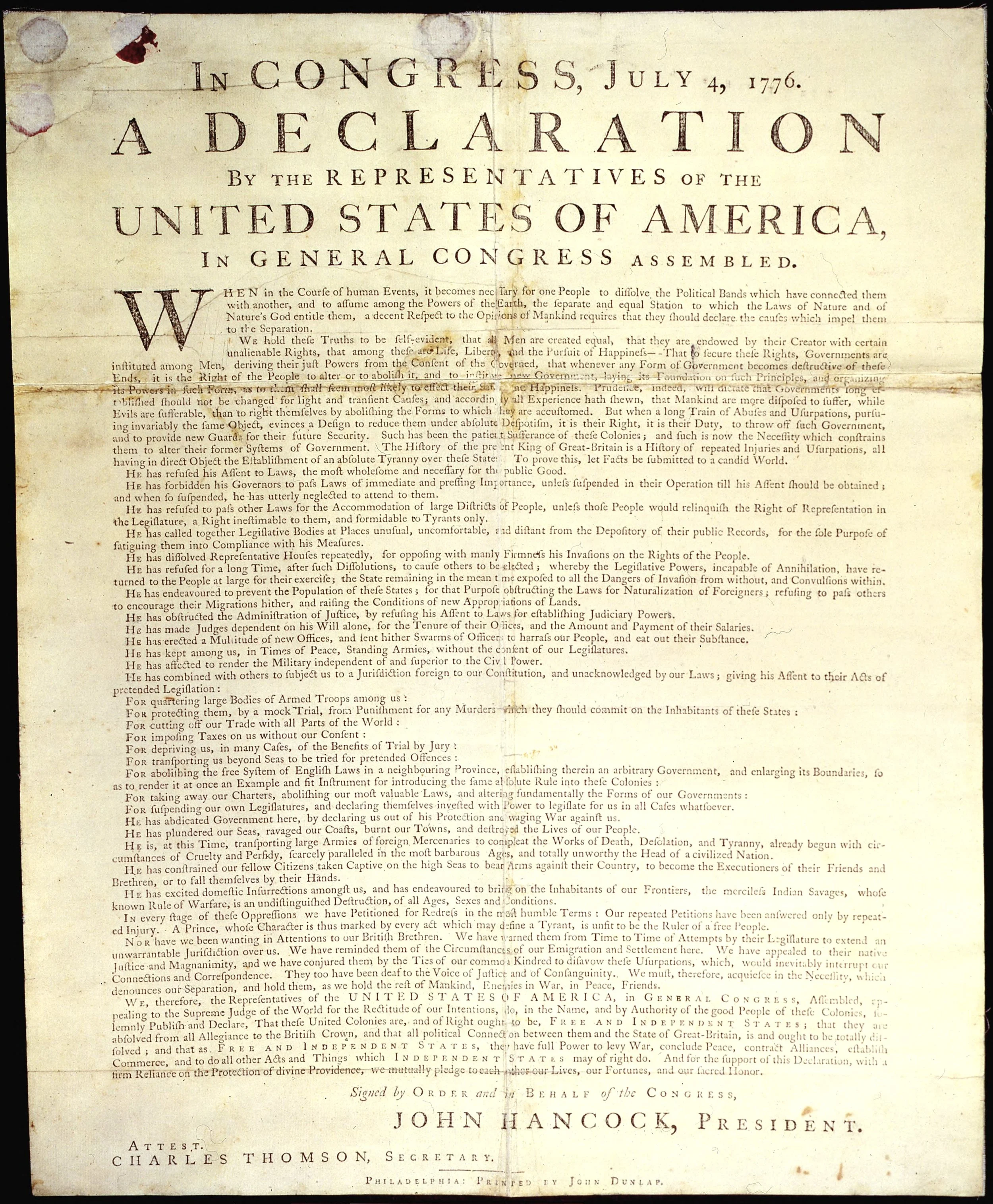
Jefferson, Thomas, and United States Second Continental Congress. 1776. Dunlap Broadside Declaration of Independence. Philadelphia, Pennsylvania: John Dunlap, Printer. Image from the Library of Congress.
Works Cited
Boyd, Julian P. 1976. “The Declaration of Independence: The Mystery of the Lost Original.” The Pennsylvania Magazine of History and Biography 100 (4): 438-67.
Declaration Resources Project. 2016. “When and How did the Colonies Find Out about the Declaration of Independence?” Cambridge, MA: Harvard Graduate School of Education.
Edmonds, John Henry. 1925. “How Massachusetts Received the Declaration of Independence.” Proceedings of the American Antiquarian Society 35 (2): 227-51.
Sneff, Emily. 2026. When the Declaration of Independence Was News. Oxford: Oxford University Press.