
Refugees in London
When I think of early immigration to the United States from the part of Europe that is now Germany, I tend to think of German settlers in Pennsylvania, many of whom were religious dissenters like the Mennonite ancestors I have written about in a previous post. As a result, I was quite surprised to learn that my seven-times great-grandfather, Johann Henrich Krantz, arrived in New York in 1710 and settled along the Hudson River in Ulster County. As I learned more about why he arrived when and where he did, I came to see many parallels between his experience and that of refugees and asylum seekers today.
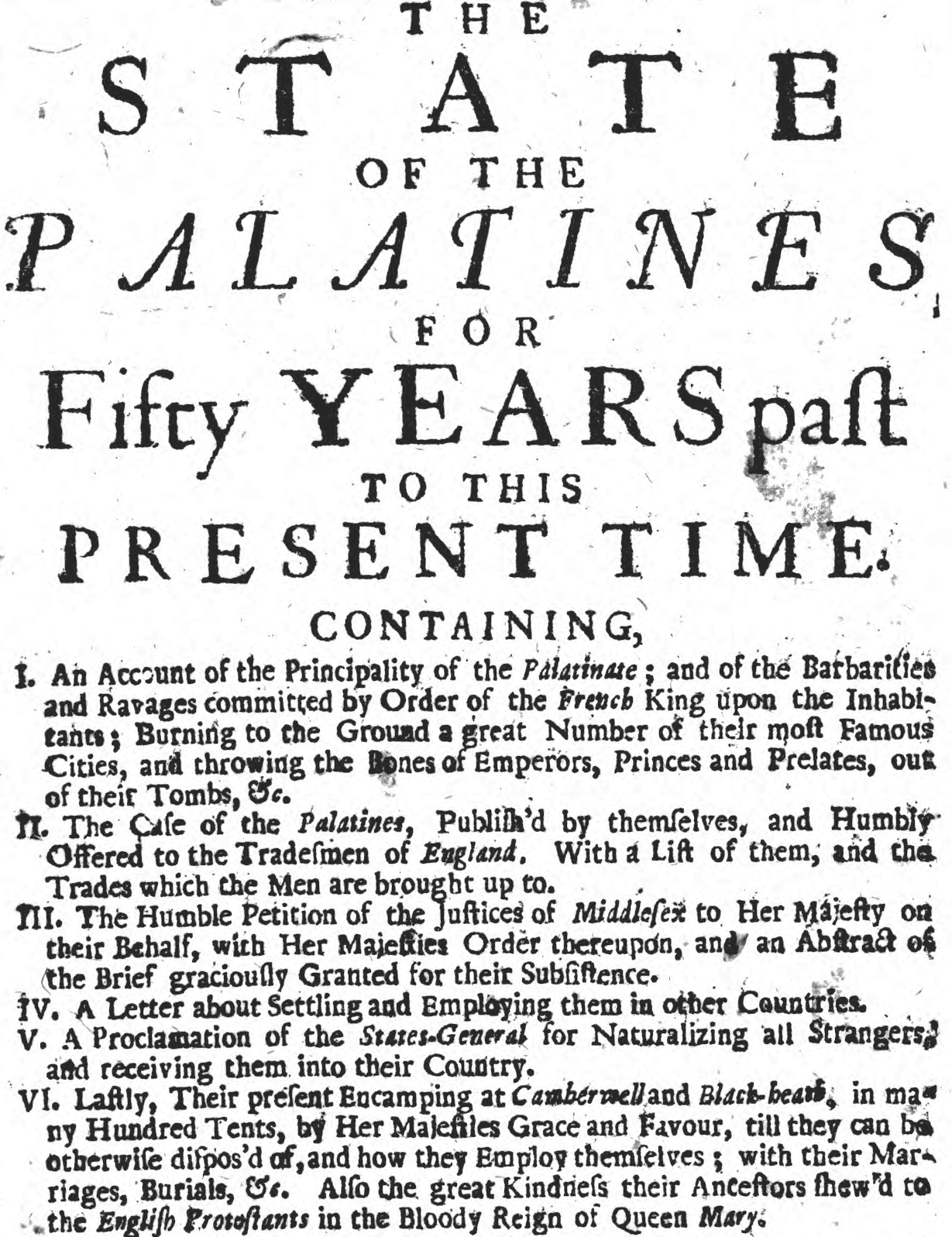
Title Page. 1710. The State of the Palatines for Fifty Years Past to this Present Time. London: printed for J. Baker.
Johann Krantz was one of more than 13,000 German-speaking inhabitants of the western Holy Roman Empire who arrived in London in the spring and summer of 1709. These individuals left their homes for economic reasons. The area around the Rhine, Main, and Neckar Rivers had been decimated during the Thirty Years War in the previous century, losing as much as three-quarters of its population. It had only recently come through the Nine Years War and was now at war again, this time over the succession to the throne of Spain. The area’s noble rulers taxed their people heavily to fund the wars and build elaborate palaces. Young men were drafted into military service. Passing armies burned towns and seized whatever they could use for supplies. An already tenuous economic situation was exacerbated by repeated outbreaks of plague and by the winter of 1708-09, which was the coldest anyone could remember (Knittle 1937; Otterness 2004).
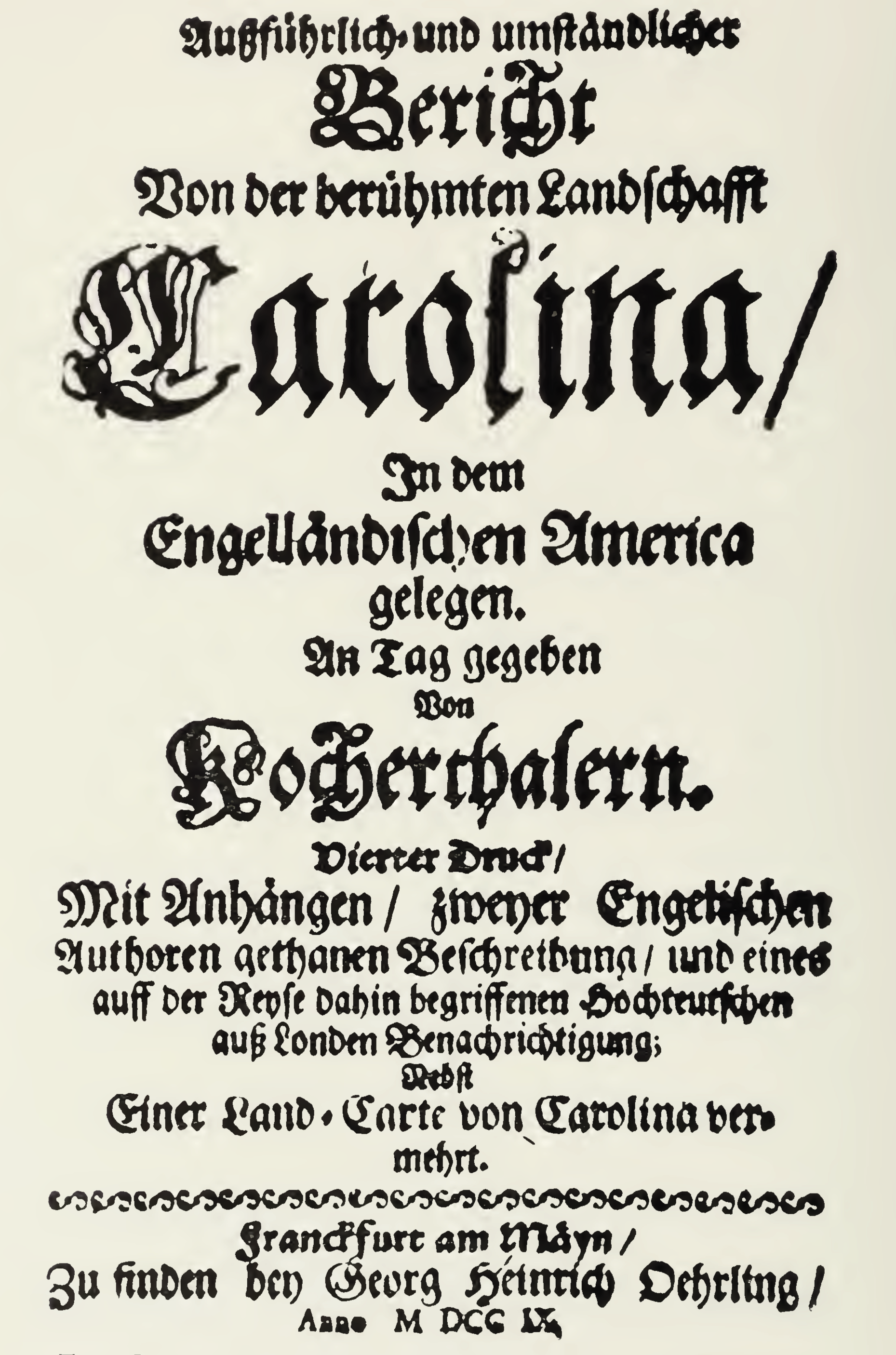
Fear of war and starvation led these people to leave their home, but what brought them to England was advertising. In 1709, a new edition of a 1706 German-language book, entitled A Detailed and Elaborate Account of the Famous Carolina Region, Located in English America, began to circulate. It contained glowing descriptions of a land of peace and plenty and was so highly decorated that people called it the “Golden Book.” Rumors circulated that Queen Anne of Great Britain had promised to provide passage across the Atlantic Ocean and free grants of land for immigrants to the American colonies. For many residents of the Palatinate and surrounding regions, that rumor was enough for them to pack their household goods, sail down the Rhine to Rotterdam, and seek passage to London.
Title Page. 1706. Joshua Kocherthal. Auβführlich und umständlicher Bericht von der berühmten Landschaft Carolina, in dem engelländischen America gelegen. Frankfurt: Georg Heinrich Oehrling.
They were helped by private funding from Dutch charitable organizations and by the goodwill of the British government, which allowed many of the immigrants to sail to London on the empty ships that had delivered British troops to the continent to fight in the ongoing war (Knittle 1937; Otterness 2004; O’Reilly 2017).
Although the British government allowed the “Poor Palatines,” as this group came to be known, to come to London, the situation once they arrived quickly became a refugee crisis on scale not previously experienced in Great Britain. The migrants were largely destitute, having spent what little money they had during their travels. Most came from rural areas, had little education, and spoke only German. Around 30% of the migrants were Catholic, a religion viewed with suspicion by the British public, and the remainder were either Reformed or Lutheran, so were Protestants but not Anglican. Most were also traveling in family groups, with children making up more than half of the migrants (Knittle 1937; Otterness 2004).
The challenge of housing and feeding the Palatines was enormous. The government put them up in rented barns, donated warehouses, and encampments in public green spaces. Charitable organizations and individuals leapt into action to provide the migrants with food, clothing, medical assistance, translators, and other needs. On the queen’s orders, a national fundraising campaign was undertaken for the support of the Poor Palatines (Knittle 1937; Otterness 2004).
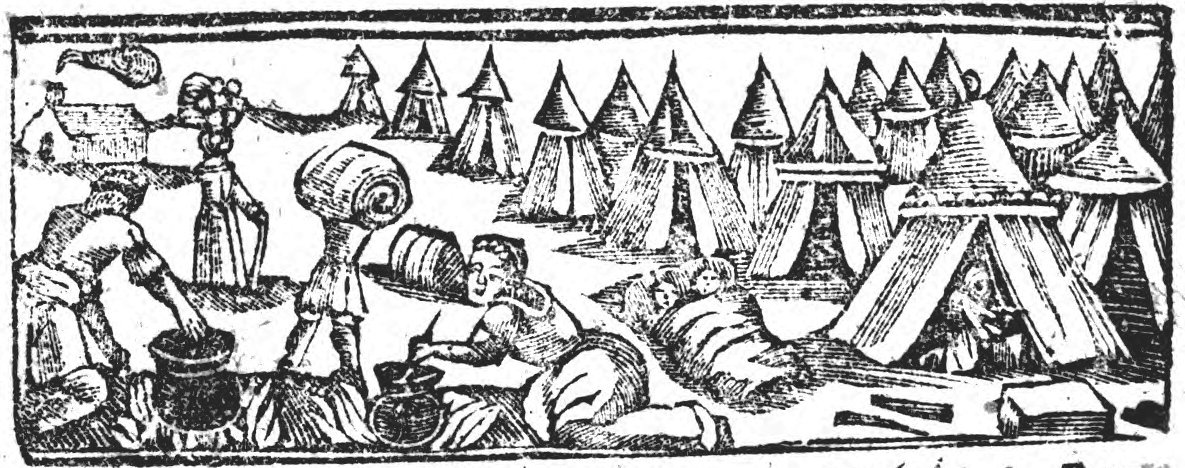
Woodcut showing the Palatines encamped on Blackheath outside London. 1710. The State of the Palatines for Fifty Years Past to this Present Time. London: printed for J. Baker, p. 16.
Initially, the British public sympathized with the plight of the Palatines. It was thought that they, like earlier Huguenot refugees from France, had suffered for their Protestant religion [1]. As time passed and the presence of so many migrants drove up the price of bread and reduced the price of labor in London, public attitudes towards the Palatines became far more negative. They were perceived as ragged and dirty, which was undoubtedly true due to their living situation, and people came to believe that they carried dangerous diseases. They also came to be seen as a burden on British society. People expressed shock at seeing Palatine women begging in the streets, and there were several violent attacks on the Palatine camps on the outskirts of London (Knittle 1937; O’Reilly 2017)
The British government was faced with, not only helping the Palatines in the short term, but also figuring out what to do with them in the long term. Great Britian was interested in promoting immigration to the American colonies. Parliament had, in fact, recently passed a law making it easier for non-British Protestant immigrants to obtain naturalized citizenship. That said, the government was entirely unprepared to cover the cost and logistics of actually sending the Palatines to America (Otterness 2004; O’Reilly 2017).
The major political parties were also deeply divided on the issue of immigration. The business-oriented Whigs, who had been the driving force behind the naturalization act, saw immigration, to both Great Britain and its colonies, as a driver of expanded industry and wealth. The more upper-class Tories, on the other hand, thought immigration would lead to social unrest and a drain on the nation’s resources. So while Parliament debated, the refugee crisis dragged on, through the winter and into the spring of 1710 (Otterness 2004; O’Reilly 2017).
As so often happens, there was no single resolution to the Palatine refugee crisis. Some migrants returned home, although most could not afford to do so. The British also sent back to the continent many of the Catholic migrants, whom they saw as undesirable citizens. Some young male migrants joined the British army, and some children were taken into apprenticeships. British towns were offered a bounty to accept some of the migrant families, but many civic leaders felt they had too many poor residents already, and even those that accepted the offer were usually unable to provide acceptable work and accommodations. Eventually, around 3,000 Palatines were resettled in Ireland, although more than half of them eventually returned to England, and another 600 families were actually sent to the Carolinas, where they had originally hoped to go. Their story was not a happy one, however, as half of the group died during the passage to North America, and many others were killed by Native Americans once they arrived (Knittle 1937; Otterness 2004; O’Reilly 2017).
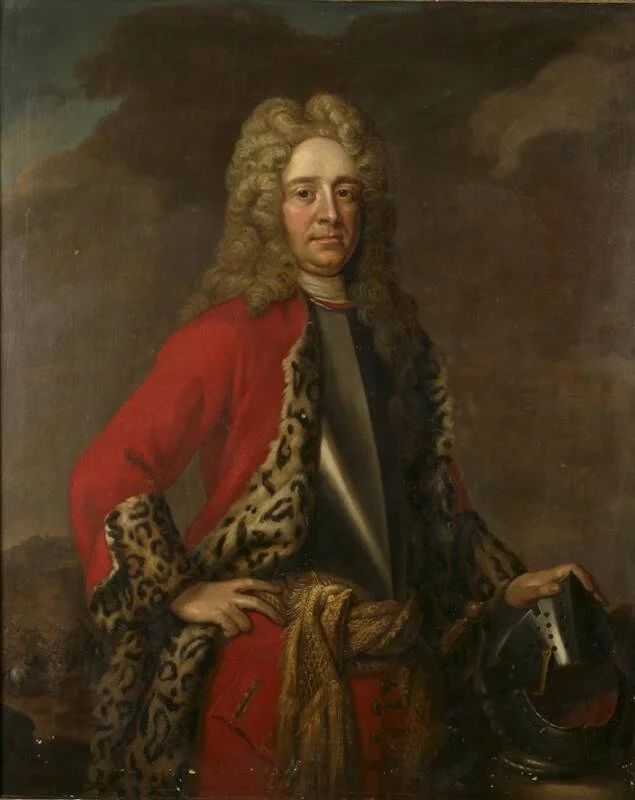
A final group of Palatine migrants, around 2,800 individuals, including my ancestor Johann Krantz and his family, were sent to New York. The new Governor of New York, Robert Hunter, proposed that the Palatines could be put to work producing pitch and tar for the British navy, which had been hampered by a Swedish monopoly on these crucial products. This work would repay the government for the cost of transporting the migrants to the colony and supporting them there. When the debt was paid off, they would receive grants of land (Knittle 1937; Otterness 2004).
Godfrey Kneller. Robert Hunter (1666-1734). c 1720. Image from the New York Historical.
After much negotiation and delay, Hunter set sail to New York City with the Palatine migrants, arriving in June 1710. In New York, the Palatines were again placed in refugee camps, living in tents on what is now Governors Island, where illness was a significant problem. Around 500 of the Palatines died on the voyage to North America or in the months after they arrived (Knittle 1937; Otterness 2004).
In the fall of 1710, the Palatines were moved to work camps—called East and West Camp—along the Hudson River about 40 miles south of Albany, where they were expected to produce pitch and tar. This effort was not a success. The Palatines, most of whom had been farmers, were not skilled at producing pitch and tar, and the expert guidance provided by the British seems to have been far from expert. The Palatine migrants were also quickly becoming frustrated with their situation. After years of travel and hardship, including the loss of many friends and relatives, they wanted the land they had been told they would receive, and most resisted being put to work making naval stores. At the same time, Hunter had gone into debt to pay for the supplies needed by the Palatines and had not been reimbursed (or paid his salary as governor) by the British government. In September 1712, he told the Palatines they would have to fend for themselves (Knittle 1937; Otterness 2004).
When this happened, the Palatines scattered across western New York and beyond. My ancestor, Johann Krantz, didn’t go very far. He moved from West Camp to Kingston, about 15 miles further south along the Hudson River. He had arrived in New York as a widower with two young children [2]. He quickly remarried and had several more children with his second wife. He and his family must have suffered greatly, both on the trip from the Rhineland to New York and once they arrived there. Nonetheless, he did become a naturalized British citizen in September 1715, and his children thrived. Five sons and a daughter survived to adulthood, settling in Ulster and Orange counties in New York and becoming prosperous farmers, as their father must have hoped when he left his home in 1709, seeking a better life for his family.
[1] The term “refugee” came into use in England in the late 1600s and originally was used only to describe people trying to escape religious persecution. Whig politicians deliberately applied the term to the Palatines to increase public sympathy for them (Otterness 2004).
[2] I do not know if Johann’s first wife died in England or on the journey to North America, but she was most likely alive when they left their home in the Rhineland. Based on German baptismal records, they also lost two small children on the journey.
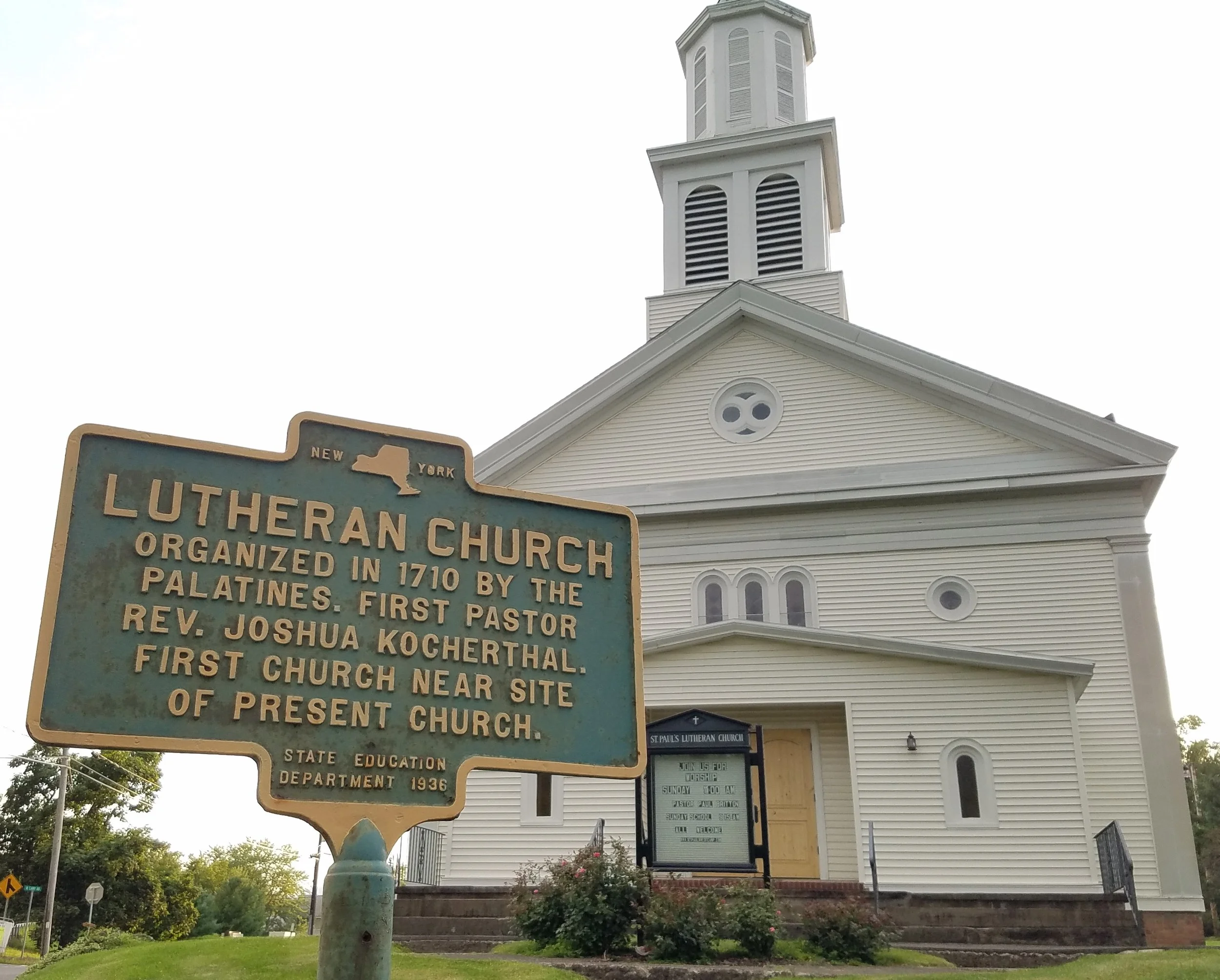
Historic marker for the Lutheran Church in the West Camp part of Saugerties, New York. August 12, 2019. Image from Wikimedia Commons.

Works Cited
Knittle, Walter Allen. 1937. Early Eighteenth Century Palatine Emigration. Philadelphia, PA: Dorrance & Company.
O’Reilly, William. 2017. “Strangers Come to Devour the Land: Changing Views of Foreign Migrants in Early Eighteenth-Century England.” Journal of Early Modern History 21 (3): 153-187.
Otterness, Philip. 2004. Becoming German: The 1709 Palatine Migration to New York. Ithaca, NY: Cornell University Press.