
At Home in the Arctic
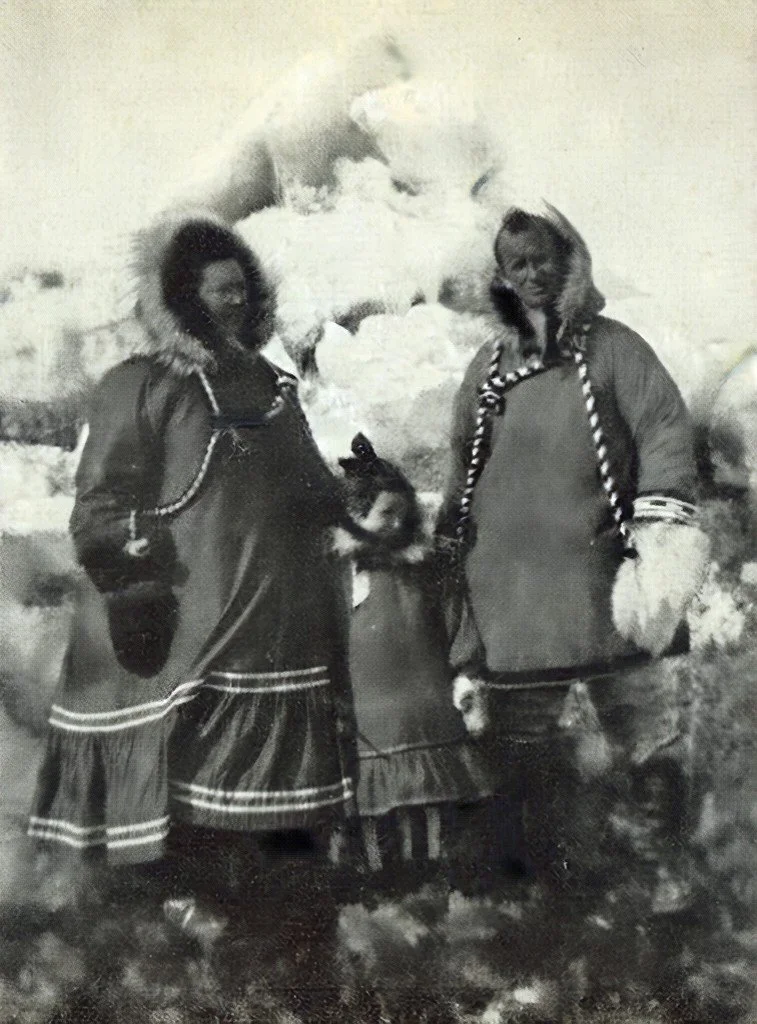
Some time ago, I wrote about my great-grandfather’s cousin Ethel Barnhart and her husband William Van Valin, who in 1911 became teachers in a school for Alaskan Natives run by the U.S. government. After four years, Will and Ethel returned to the continental United States, bringing with them a large collection of Native Alaskan artifacts, many of which they sold to the Penn Museum, a Philadelphia anthropological museum affiliated with the University of Pennsylvania. A few years later, when the Penn Museum was offered funding for a research expedition to northern Alaska, museum staff turned to Will to lead the effort (Van Valin 1944).
Ethel, Olive, and William Van Valin in Alaska. c. 1918. In William B. Van Valin. 1944. Eskimoland Speaks. Caldwell, Idaho: The Caxton Printers. After page 226.
The funder of the expedition was John Wanamaker, the multimillionaire founder of Wanamaker’s, the first department store in Philadelphia; a former Postmaster General of the United States; the vice-president of the Penn Museum’s Board of Managers; and a dedicated collector of art and antiquities (Ruwell & King 1983). His son Rodman had, between 1908 and 1913, funded three expeditions to various Native American nations, during which the expedition leaders collected artifacts and ethnographic information and took photographs of tribal life. Wanamaker was perhaps thinking of these journeys when he offered to pay for an expedition along the northwestern coast of Alaska. The purpose of the expedition, as Will Van Valin explained in his book Eskimoland Speaks, was to gather information on the native people of this region, including “their traditions, folklore, origin, and descent—anthropological, archaeological, and ethnological” (Van Valin 1944, p. 123).
The social scientific focus of the expedition reflects the rise of anthropology as an academic discipline. During the 18th and 19th centuries, the nature of human society was the subject of philosophers. Efforts to directly observe the culture of ancient or non-European societies had typically been conducted by wealthy amateurs, who did not always take care to accurately record or preserve what they found. This situation changed in the late 19th and early 20th centuries when researchers began to conduct ethnographic fieldwork among indigenous people and more rigorous digs at ancient sites.
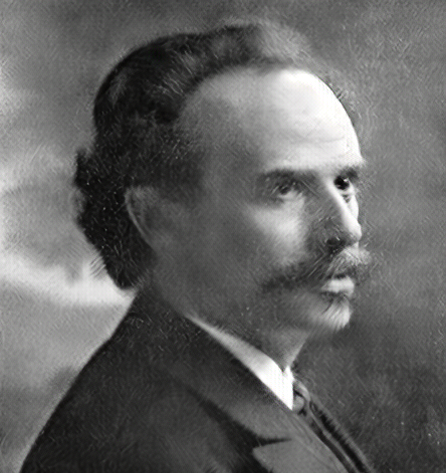
Of particular importance was the work of Franz Boas, a German scholar who became a professor at Columbia University in 1899. Boas went on to train a generation of well-known American anthropologists, each of whom embraced his core belief that human society and culture could only be understood through empirical observation (Ericksen & Nielsen 2013).
Professor Franz Boas, Vice-President of the Section for Anthropology, American Association for the Advancement of Science. March 1908. The Popular Science Monthly. Page 288.
Armed with funding and credentials from the Penn Museum, Will Van Valin set sail from Seattle, accompanied only by an interpreter, Paul Patkotak. The original plan was to set up headquarters in Nome and sail the Northern Alaskan coast from there, collecting artifacts and documenting native Alaskan life through motion pictures. Once in Nome, however, Will discovered that he had quite a bit of competition. At least four other men were there collecting artifacts, hiring all available local labor, and inflating the prices for native-made goods. Given these circumstances, Will decided to head north to Point Barrow, above the Arctic Circle. Accompanied by his wife Ethel and their seven-year-old daughter Olive, Will set sail along the coast, arriving in September 1917 at the place that would be their home for the next two years (Van Valin 1944).


(left) Exterior view of the Van Valin home in Point Barrow, Alaska. c 1918. (right) Olive and William Van Valin in the Van Valin home in Point Barrow, Alaska. c 1918. In William B. Van Valin. 1944. Eskimoland Speaks. Caldwell, Idaho: The Caxton Printers. After page 148.
Once at Point Barrow, the Van Valins settled in for a long stay. With help from local residents, Will built a wooden house for them, which they insulated with snow and ice during the winters. The house was heated by a large stove they had brought with them from Nome, but interior temperatures in the winter were still cold enough that moisture seeping through the wooden walls would freeze (see photos above). The highlight of the expedition, from the family’s perspective, was the birth in April 1918 of William Van Valin, Jr., the second white child born in the Arctic. [1] In newspaper interviews, William Sr. was very pragmatic about having a child in such cold conditions. As he explained:
As soon as he was big enough, Mrs. Van Valin put him in a little suit of fur from top to toe, and then made a hood in her own suit, so that she could carry him outdoors on her back. His sister, who was eight years old, also carried him about on her back. The little fellow was perfectly well and happy, and both of them escaped the children’s diseases that one finds here in the cities (“Arctic Explorer” 1920).
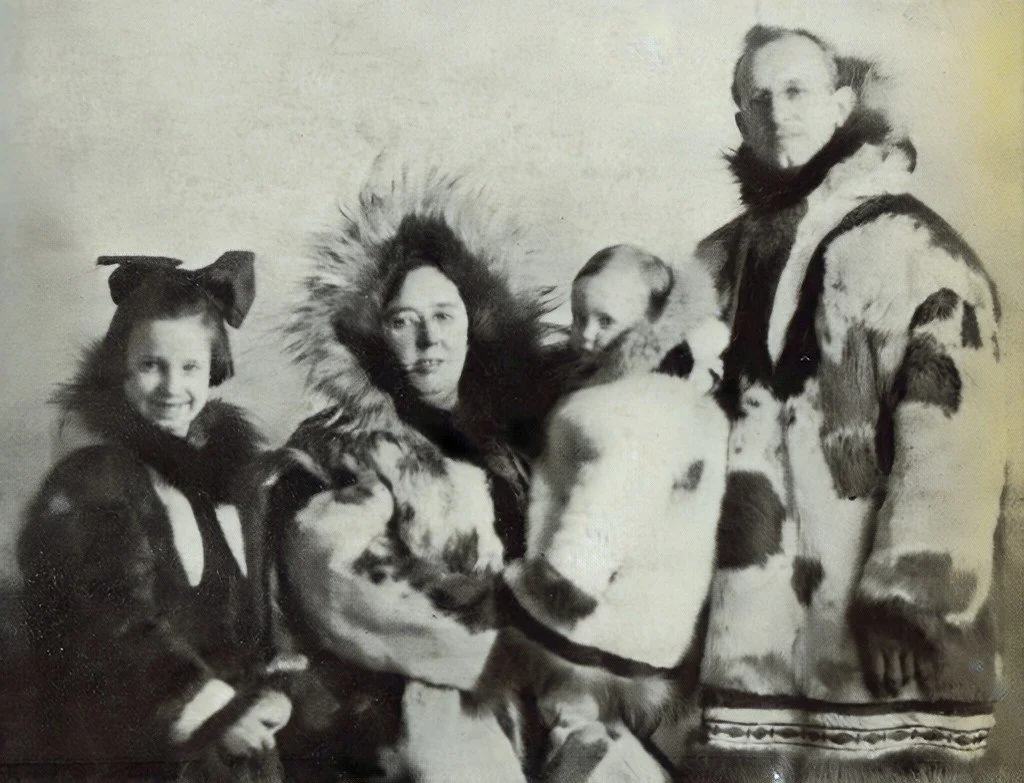
The Van Valin Family: Olive, Ethel, William Jr, and William Sr. c. 1919. In William B. Van Valin. 1944. Eskimoland Speaks. Caldwell, Idaho: The Caxton Printers. After page 132.
The birth of William Jr. may have been the expedition’s high point for the Van Valin family, but from a scientific perspective, the most significant discovery was a series of mounds containing human remains wrapped in furs, together with many artifacts. Initially, Will believed the mounds to be what was left of a town whose inhabitants had succumbed to some disaster, but later research concluded that they were burial mounds and the artifacts were grave goods. In fact, researchers from the Penn Museum and the Smithsonian Institution ultimately concluded that the mounds were ancient burials from the Birnirk Culture, whose people lived in Siberia and northern Alaska from 500-1000 C.E. and are believed to be the ancestors of the modern Iñupiat people (Ruwell & King 1983).
William Van Valin’s discovery of these burial mounds and his removal of the human remains and artifacts to Philadelphia allowed researchers to make important discoveries about an ancient Alaskan culture, but it also gave him considerable publicity and the opportunity to build a lucrative career as a speaker and writer. Anthropologists of the era were eager to distinguish themselves from grave robbers who dug up ancient sites for profit, but the ethical considerations are more complex (Pöhl 2008). Even at the time, the removal of the remains created controversy. In October 1919, after the expedition had concluded, the Juneau Empire published an article about a complaint filed with the Alaskan territorial government by the commissioner at Point Barrow, alleging that the remains had been dug up without a legally required permit and that they were not ancient bones at all but rather “plain everyday dead Eskimos who had died in the ordinary course of events” (“Eskimo Bones” 1919). While the commissioner was certainly wrong about the age of the remains and nothing seems to have come from his complaint, his concerns suggest that some residents of the area were uncomfortable with the excavation.
An afterwards to this story came in 1993, when the Inupiat History, Language and Culture Commission of the North Slope Borough Planning Department requested, under the 1990 Native American Graves Protection and Repatriation Act (NAGPRA), the return of all human remains taken from their region. The Smithsonian Institution did return remains dated from 1500 C.E. and later but not earlier ones, including those found by William Van Valin. The Smithsonian’s’ conclusion was that the earlier people had abandoned the region for several hundred years and could not have left behind any lineal descendants. As anthropologist Stephen Loring has argued, this interpretation of ancestry places scientific objectivity above the more subjective feelings indigenous people may have about their identity. As he explains, “The relationships that groups construct between themselves, between the present and the past, between artifact and site, lie at the heart of identity and claims of significance and meaning” (Loring 2008 p 188). Happily, in 2024, the Bureau of Land Management Alaska opened the door to new requests for repatriation of these remains and associated artifacts, now in the possession of the Penn Museum, citing “a reasonable connection between the human remains and funerary objects described in this notice and the Native Village of Barrow Inupiat Traditional Government” (“Notice” 2024).
[1] The first white child born in the Arctic was Marie Peary, daughter of explorers Robert and Josephine Diebitsch Peary, who was born in Greenland in 1893.
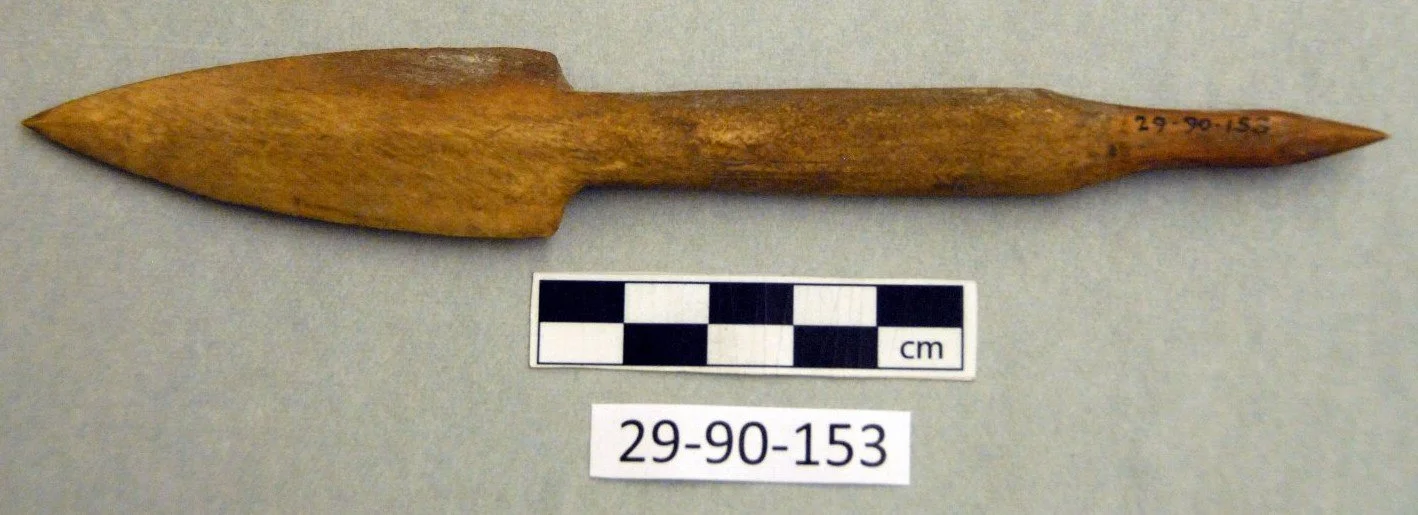
Object # 29-90-153. Arrowhead made of antler. Birnirk Culture. Point Barrow, Alaska. Collected by William Van Valin during the Wanamaker Expedition to the Point Barrow Region, 1917-19. Image from the Penn Museum.
Works Cited
“Arctic Explorer Just Back from Alaska.” February 8, 1920. Detroit Free Press (Detroit, Michigan). Page 94.
“Eskimo Bones Not Old Ones It Is Claimed.” October 28, 1919. Juneau Empire (Juneau, Alaska). Page 3.
Eriksen, Thomas Hyllan, and Finn Sivert Nielsen. 2013. A History of Anthropology. Second Edition. London: Pluto Press.
Loring, Stephen. 2008. “The Wind Blows Everything off the Ground: New Provisions and New Directions in Archaeological Research in the North." In Opening Archaeology: Repatriation’s Impact on Contemporary Research and Practice. Thomas W. Killion, ed. Santa Fe, NM: School for Advanced Research Press. Pages 181–194.
“Notice of Inventory Completion: U.S. Department of the Interior, Bureau of Land Management, Alaska State Office, Anchorage, AK.” September 10, 2024. Federal Register 89 (175): 73440.
Pöhl, Friedrich. 2008. “Assessing Franz Boas' Ethics in his Arctic and Later Anthropological Fieldwork.” Études Inuit Studies 32 (2): 35-52.
Ruwell, Mary Elizabeth, and Eleanor M. King. 1983. “Rediscovering the Eskimo." Expedition Magazine 25 (2).
Van Valin, William B. 1944. Eskimoland Speaks. Caldwell, Idaho: The Caxton Printers.