
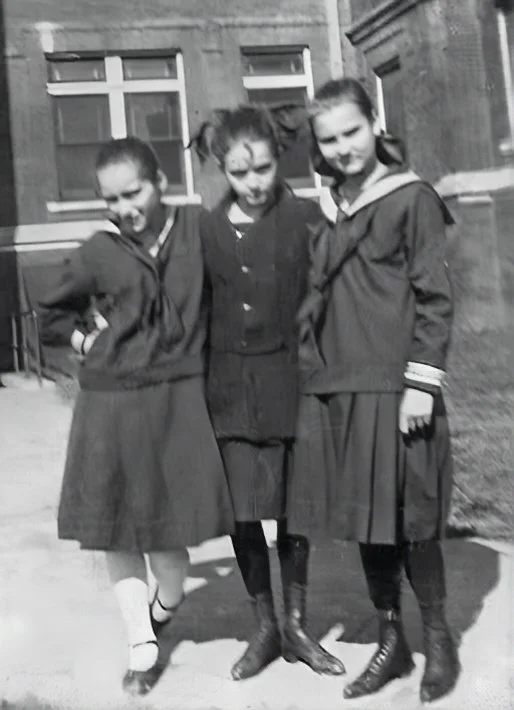
As I wrote in a recent post, my great-grandfather Frank Barnhart was an oil driller who worked the North Texas oil boom. At the time, my grandmother Dorothy Barnhart was 11 years old, ready to start 6th grade, and Frank and his wife felt that an oil boom town wasn’t the best place for her to get an education. They decided to send her to boarding school at Our Lady of Victory Academy, a Catholic girls’ school in Ft. Worth, Texas.
Dorothy Barnhart (right) and unknown friends at Our Lady of Victory Academy. 1919-20. Ft. Worth, TX. Barnhart family photo.
Ft. Worth was a logical place for Dorothy to attend school while her parents lived closer to the oil fields. Even before oil was discovered in Eastland County, 90 miles west of the city, Ft. Worth had become a railroad hub and a center for the banking and cattle industries (Myres 1968). World War I brought Camp Bowie, a massive U.S. Army training facility, built on land leased from the city and converted to a residential area after the war. During the oil boom, Ft. Worth became the base for oil companies, wildcatters, and oil promoters. New office buildings and houses were quickly built, and the population grew by leaps and bounds (Schmelzer 1952; Hinton & Olien 2002).
City promoters, eager to erase the city’s earlier reputation as a purveyor of rowdy entertainment for visiting cowboys (Myres 1968), placed newspaper ads like the one below, highlighting the city’s cultural advantages. Beautification efforts abounded, and educational and cultural institutions benefited from new oil wealth. Texas Christian University and the Southwestern Baptist Theological Seminary, both of which had moved to Ft. Worth from Waco in 1910, were among the beneficiaries, as were the Carnegie Library and its associated art gallery, which eventually became the Modern Art Museum of Ft. Worth (Schmelzer 1952; Hinton & Olien 2002).

“Fort Worth is A Center of Education, Music and Art.” October 16, 1921. Fort Worth Record Telegram. P. 14.
Our Lady of Victory Academy was a part of Ft. Worth’s shift from cattle town to cultured urban center. It was founded by the Sisters of St. Mary of Namur, an order that played an extensive role in Catholic education in North Texas. Members of the order arrived in Texas in 1873 and established Sacred Heart Academy in Waco, followed by schools in Corsicana, Denison, and Sherman. The sisters, who came originally from Belgium, must have found Texas an alien world. They were forced to contend with extreme weather, outbreaks of disease, wild animals, fear of attacks by Native Americans, and lynchings by members of the Ku Klux Klan, who often harassed Catholics as well as people of color (Bole 2016; Henry 2023).
The Sisters of St. Mary of Namur arrived in Ft. Worth in 1885 and established St. Ignatius Academy. At that time, Ft. Worth was still the epitome of the wild West, and the school was located in a district known as “Hell’s Half Acre,” home to saloons, dance halls, and brothels (Myres 1968). The sisters taught the daughters of Catholic workers who came to Texas to work on the railroads and collaborated with city leaders on civic improvement projects. As Ft. Worth grew, so did the number of prospective students, and many families in outlying areas opted to send their daughters to school in the city, even if it meant they needed to board there. In 1909, the sisters chose to continue St. Ignatius as a day school and built a new boarding school on a large piece of land in the well-to-do South Hemphill neighborhood, at the last stop on the streetcar line (Bole 2016; Henry 2023).
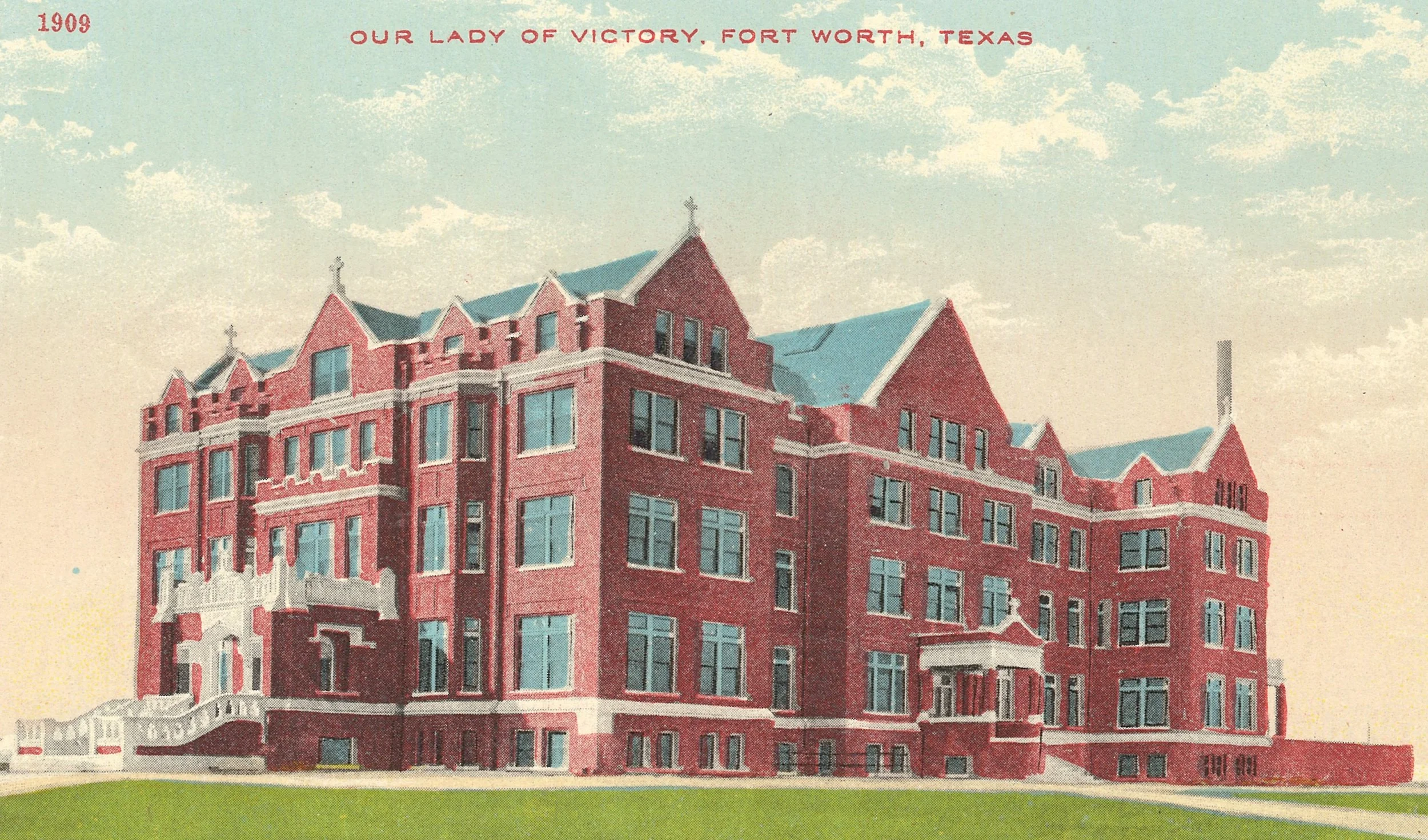
Our Lady of Victory, Fort Worth, Texas. 1909. Postcard. S. H. Kress and Co.
Our Lady of Victory Academy was a model convent school, providing an education that was “thorough, practical and refined” (Our Lady of Victory College and Academy, p. 5). Its building stood four stories tall and was fitted with an elevator for ease of access. In addition to providing a convent for the nuns, the building housed a chapel, an auditorium, a kitchen and dining hall, dormitories, two libraries, science labs, music rooms, and classrooms. The surrounding grounds provided recreational activities for the nuns and their students. The education provided was excellent, as well. Secondary courses were offered in English, Latin, modern languages, history, math, and science, and the primary school taught similar subjects. Optional lessons in art, music, and elocution were offered, and students were taught physical education and domestic science, with special attention to cooking, sewing, and laundry. As of 1919, the cost for this education, including tuition, board, and laundry service, was $150 per year, close to $3,000 in current dollars (Our Lady of Victory College and Academy 1919-20).
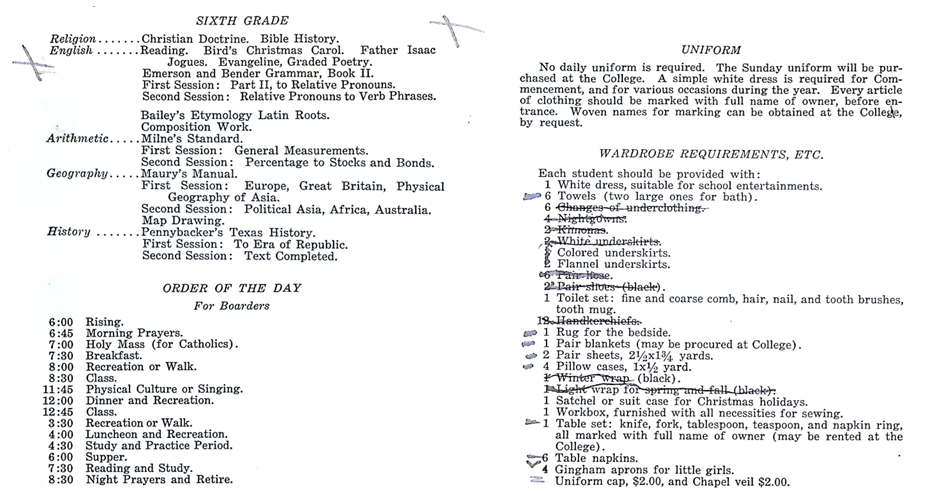
Our Lady of Victory College and Academy. 1919-20. Ft. Worth, TX: Sisters of St. Mary of Namur. P. 9-10 and 24-26. Annotations in original handbook owned by Barnhart family.
From a 21st century perspective, it can be hard to recognize how extraordinary it is that Our Lady of Victory (OLV) was offering college-preparatory education to girls in a Texas city that only a few decades before had been a stop on the Chisolm Trail. And they did not teach only Catholic children. As the 1919-20 student handbook put it, “Students of all denominations are received. No undue influence is exercised over the religious views of non-Catholic students” (Our Lady of Victory College and Academy, p. 6). This radical spirit continued at OLV through 1953, when it became the first racially integrated school in Ft. Worth (Bole 2016). Sadly, OLV closed its doors in 2021, and the building where my grandmother went to school is now loft apartments (Smith 2021).
Reading the history of OLV and seeing the pictures of it in my grandmother’s time have brought back many memories for me. I attended OLV myself, some 50 years after my grandmother was there. By the time I enrolled, OLV served kindergarten to 8th grade in a building separate from the original academy and convent, although we did still go to that building for music classes and religious services. I went on to complete my secondary education at Nolan Catholic High School, which was founded through a merger of OLV’s high school with a Catholic boy’s high school, and I think both schools gave me an excellent education, although they did not teach me the key skills of cooking, sewing, and laundry.
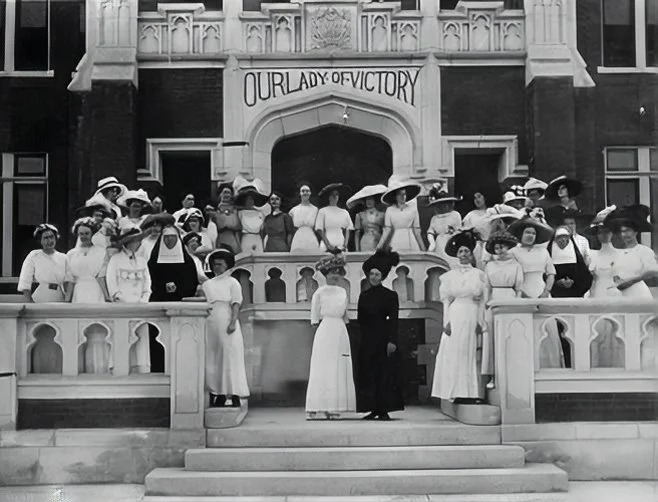
Students and Nuns at Our Lady of Victory Academy. 1911. University of North Texas Libraries, The Portal to Texas History, crediting Tarrant County College Northeast, Heritage Room.
Works Cited
Bole, Sister Mary Brian. 2016. They Came to Serve: A Chronicle of Women Religious in the Diocese of Dallas, 1874-2014. Dallas, TX: Diocese of Dallas Archives.
Henry, John. December 19, 2023. “A Little Good: The Sisters of St. Mary of Namur and 150 Years in Texas.” Fort Worth Inc.
Hinton, Diana Davids, and Roger M. Olien. 2002. Oil in Texas: The Gusher Age. Austin, TX: University of Texas Press.
Myres, Sandra L. 1968. “Fort Worth, 1870-1900.” The Southwestern Historical Quarterly 72 (2): 200-222.
Our Lady of Victory College and Academy. 1919-20. Ft. Worth, TX: Sisters of St. Mary of Namur.
Schmelzer, Janet. 1952 (updated 2025). “A Comprehensive History of Fort Worth, Texas.” Handbook of Texas. Austin, TX: Texas State Historical Association.
Smith, Matthew. April 27, 2021. “Tears, Faith, and Memories Accompany Our Lady of Victory School’s Pending Closure.” North Texas Catholic.