
Drilling Rigs and Boomtowns
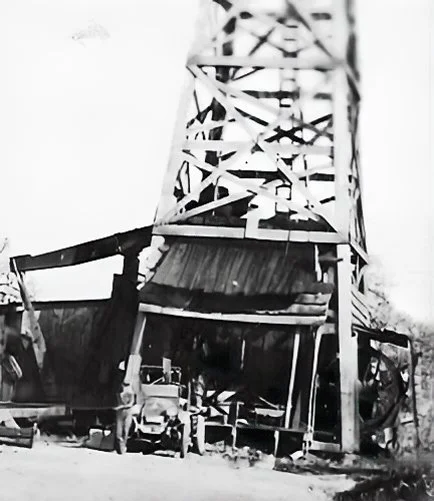
When I was in high school, I went on a summer program to England. That was during the era of the television show Dallas, and as a Texan, I got the usual questions about horses, cowboys, and oil wells, none of which I knew much about. The funny thing is that my family, like many others in the state, actually does have a strong connection to the Texas oil industry. In fact, my Barnhart great-grandparents would never have come to Texas if it hadn’t been for the lure of “black gold.” But America’s search for oil didn’t actually begin in Texas. The first oil boom in the U.S. took place nearly half a century earlier in Pennsylvania, and that’s also where my family’s story begins.
J.W. Jones oil well #1. Humble Oil & Refining. Ranger Texas. c 1920. Barnhart family photo.
The existence of oil in western Pennsylvania was well known in the 19th century. For the most part, it was considered a nuisance because it seeped to the surface and rendered the land useless for farming. During the 1850s, however, advances in technology allowed crude oil to be refined into kerosene and used as lamp oil, replacing rapidly depleting supplies of the whale oil commonly used prior to that time. After the first oil well was drilled in Titusville, Pennsylvania, in 1859, people rushed to join the boom, building oil wells and refineries across western Pennsylvania and eastern Ohio (Ginsberg 2009).
A pattern of boom (and often bust) was common in the emerging oil industry. Once oil was found in any particular area, speculators moved in, leasing property, buying mineral rights from local landowners, and digging wells in hopes of hitting a gusher. These oil wells attracted workers, some from nearby farms hoping for a chance at a different life and many from other oil fields where work dried up along with the wells. To house the workers, boomtowns sprang up, with hastily built housing, dirt streets, and few luxuries. These towns, in turn, attracted cooks, cleaners, retailers, tavernkeepers, and prostitutes, all of whom were ready to provide services for the oil workers (Weaver 2010).
This world of boomtowns was one well known to my relatives. My great-grandfather, Frank Barnhart, was born Pennsylvania in 1884 and got his start in the oil industry as a young man. in 1900, at the age of 16, he was working as a stationary engineer— responsible for the operation and upkeep of various machinery—at the tank farm, an oil storage facility, managed by his father in eastern Ohio. By 1910, Frank had moved into the position of pumper in an oil works, responsible for monitoring and maintaining the production of the active oil wells in a specific area (Weaver 2010).
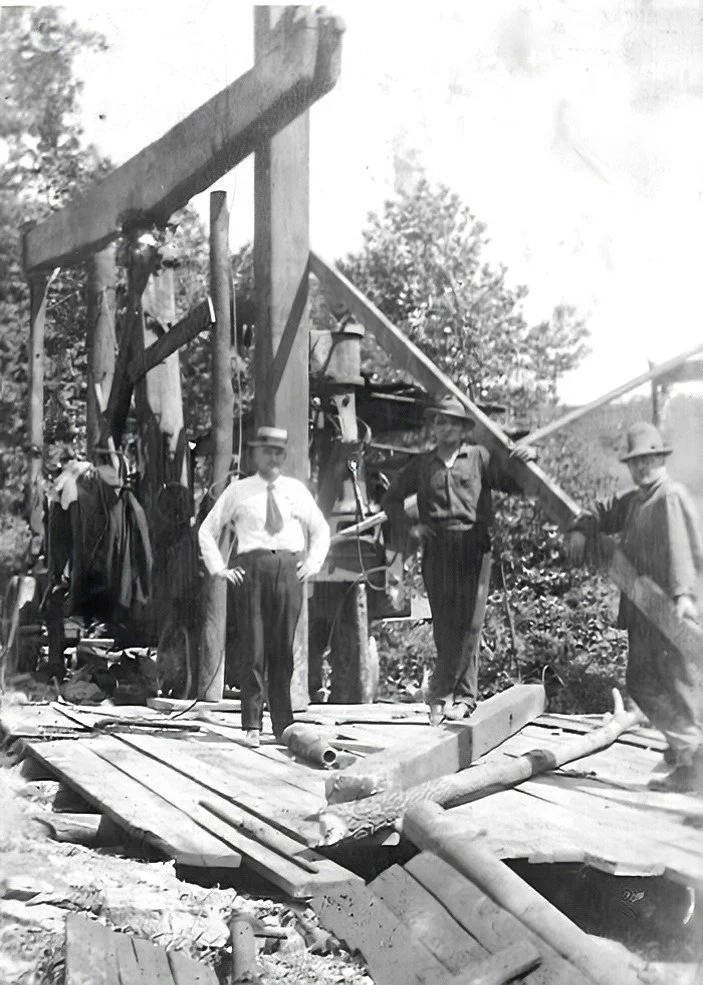
During the next decade, Frank put his knowledge of the oil industry to good use by launching an oil drilling firm. Because oil wells only have to be drilled once and the process requires special expertise and equipment, most oil companies hired drilling firms on a contract basis. Drilling for oil can be dangerous work, with ever-present risks of sinkholes, steam explosions, natural gas pockets, and fires, and the drillers of the oil boom era were well-paid for the risks they took. Oil drillers in this era also had to be on the move, heading to wherever new oil fields were found (Weaver 2010). Frank Barnhart was no different. During the 1910s, he drilled wells in the Glenn Pool oil field in Oklahoma, the Shinnston and Sistersville oil fields in West Virginia, and the Big Sinking oil field in Kentucky.
Building a drilling rig. Beattyville, KY. Date unknown. Barnhart family photo.
By 1920, Frank, his wife Hettie, and their only child, my grandmother Dorothy, had arrived in Texas, the mecca of the oil industry. Texas didn’t have just one oil boom. It had many, spread across the state. While the first Texas oil well was drilled in 1866, the state initially lacked the infrastructure needed to compete with the oil industry in the Northeast. By the turn of the century, with growing industrialization and the arrival of railroads across the state, that situation had changed.
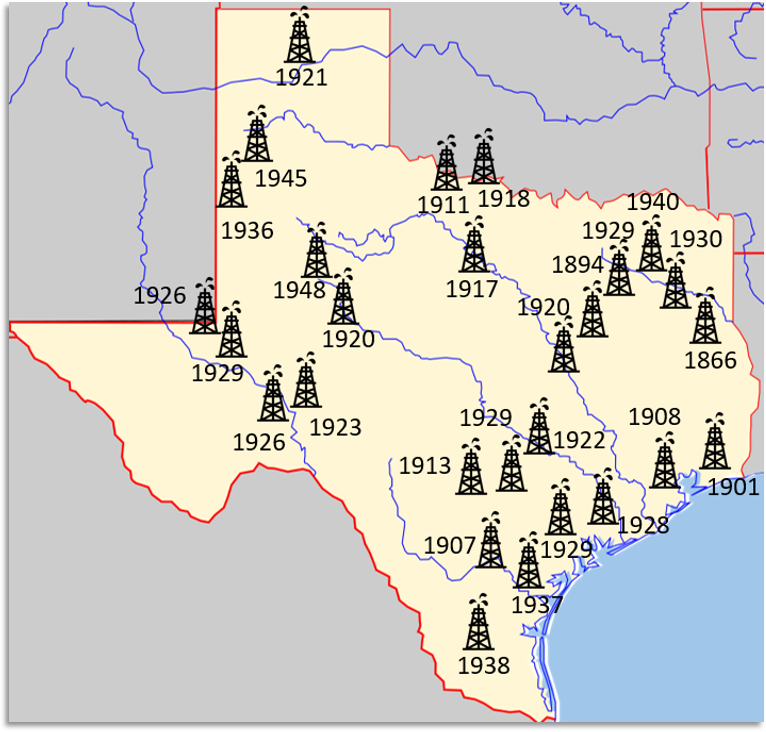
From the first small oil wells drilled in Corsicana in the 1890s and the1901 gusher at Spindletop in southeast Texas to the discovery of the enormous East Texas oil field in 1930, the development of new oil extraction facilities became a main driver of the state’s economy, politics, and culture in the first half of the 20th century, with oil ultimately being produced in 80% of the state’s counties (Hinton and Olien 2002; Weaver 2010; Haile 2015).
Map showing significant oil discoveries in Texas. Age of Oil: Oil Transforms Texas. Texas History for Teachers Project. Denton, TX: University of North Texas Libraries.
At the time the Barnharts arrived in Texas, oil development in the state was focused on north Texas, particularly the Ranger oil field, located in Eastland County, west of Fort Worth. This oil field was discovered in 1917 and contained substantial quantities of high grade oil. In the three years from 1917 to 1920, over 1,000 oil wells were drilled in the area, yielding some 20 million barrels of oil (Reeves 1923). Local landowners became rich leasing land to oil companies and earning royalties on mineral rights, and the tiny town of Ranger boomed seemingly overnight. Speculators, oil field workers, and service providers poured into the town, sleeping in barns and the Army surplus tents readily available in the wake of World War I. In the dry climate of north Texas, potable water became a particular concern, and cafes in Ranger sold a glass of ice water for the same price as a soft drink (Hinton and Olien 2002; Weaver 2010; Haile 2015).
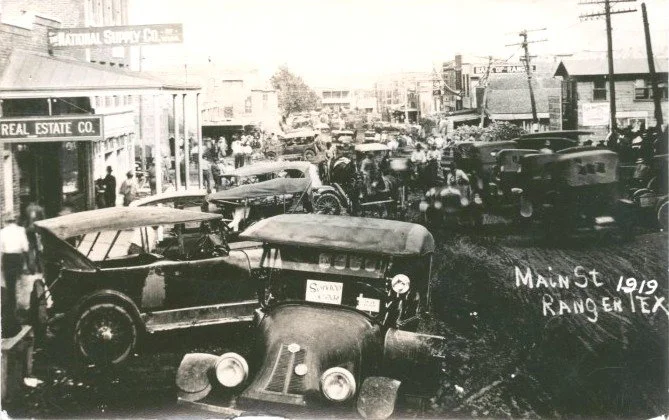
Main St. Ranger, Tex. 1919. University of North Texas Libraries, The Portal to Texas History, crediting Permian Basin Petroleum Museum, Library and Hall of Fame.
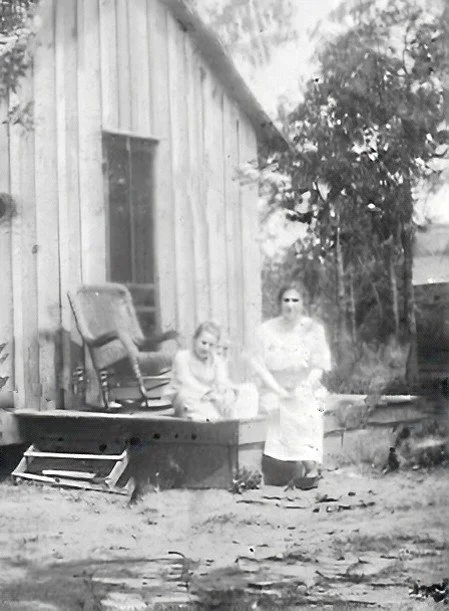
The Barnharts settled, not in Ranger itself, but in the town of Gorman, some 20 miles away. This was a prudent choice. Oil boomtowns were notoriously lawless, with local governments hard-pressed to curb the behavior of hard-drinking oil field workers prone to gambling , fighting, and womanizing. Ranger was among the worst of the boomtowns. Robberies and murders in the town reached an all-time high in 1919, and only raids by the Texas Rangers and a ban on carrying guns in town made the streets safe to walk (Weaver 2010; Haile 2015). In Gorman, the Barnharts found a quieter place to live, albeit in a house they called “the Shack,” one of the many buildings typically thrown together by oil companies for contractors and employees and their families (Hinton and Olien 2002).
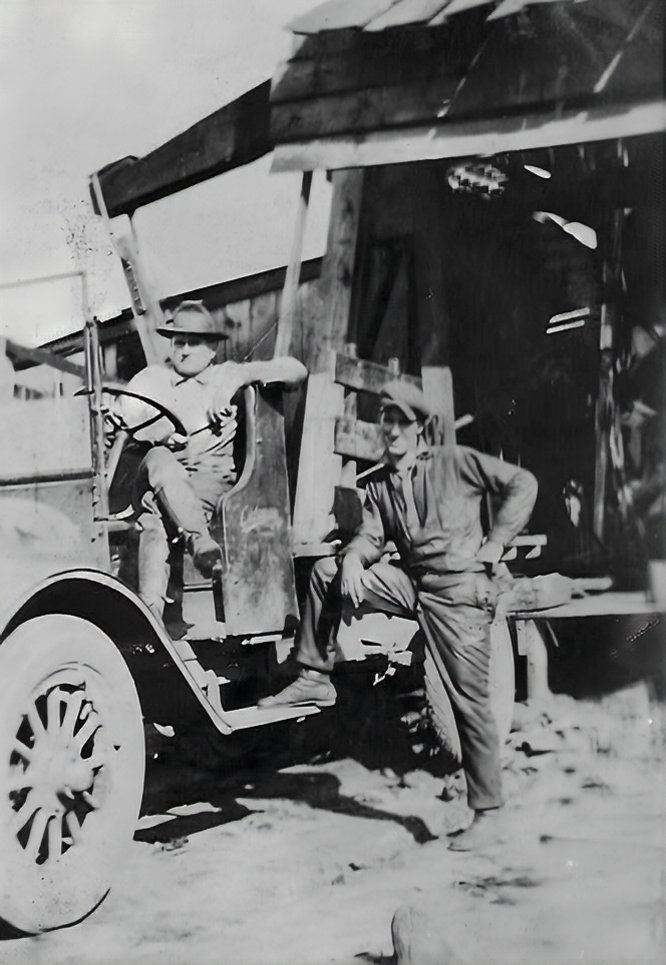
(left) Frank Barnhart (in car) and unidentified man at the J.W. Jones oil well #1. Humble Oil & Refining. Ranger Texas. c 1920. Barnhart family photo.
(right) Dorothy and Hettie Barnhart in front of “the Shack.” Gorman, TX. c 1920. Barnhart family photo.
The Ranger oil boom ended almost as quickly as it had begun. Oil production from the field peaked in 1919, and by 1922, the wells were largely played out. The oil field workers and just about everyone else moved on to greener pastures elsewhere in the state (Hinton and Olien 2002; Weaver 2010; Haile 2015). Frank Barnhart was hit hard by the end of the boom. He had gone into partnership with a well-known Texas driller named Fred Moellendick, the inventor of a wire splicing tool widely used in oil fields. The firm of Moellendick and Barnhart had been riding high, purchasing two Hudson Phaetons in 1920. By 1922, though, the firm had been dissolved, and within a few year, Moellendick was facing multiple lawsuits for unpaid bills.
The Barnhart family moved back to Ohio for a few years, while my grandmother was in high school, but by 1928, they were back in Texas. They arrived just in time for the discovery of the East Texas oil field. The boomtown scenes from Ranger were repeated in towns like Kilgore, at the very center of the oil field. The outcome of this boom was a little different, however. The vast quantities of oil available by 1930 were causing massive price drops in an economy already reeling under the effects of the Great Depression. The Texas Legislature and the Texas Railroad Commission, tasked with regulating oil production, intervened ineffectively until finally, in 1931, the governor sent in the National Guard to shut down the field (Hinton and Olien 2002; Haile 2015). Additional legislation in 1935 finally reduced overproduction, and the East Texas oil field continues to produce today, through the oil wells I always saw pumping when driving to visit my grandparents in east Texas as a child.
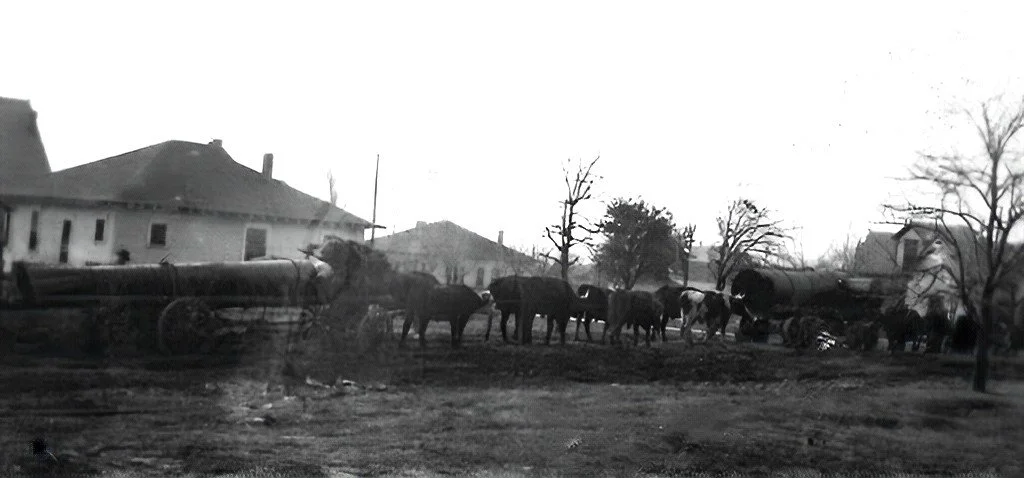
Oxen pulling oil drilling rig equipment. Gorman, TX. c 1920. Barnhart family photo.
Works Cited
Ginsberg, Judah. 2009. The Development of the Pennsylvania Oil Industry. Washington, DC: American Chemical Society.
Haile, Bartee. 2015. Texas Boomtowns: A History of Blood and Oil. Charleston, SC: The History Press.
Hinton, Diana Davids, and Roger M. Olien. 2002. Oil in Texas: The Gusher Age. Austin, TX: University of Texas Press.
Reeves, Frank. 1923. “Geology of the Ranger Oil Field, Texas.” In Contributions to Economic Geology (short papers and preliminary reports), 1922: Part II. Mineral Fuels. Ed. K.C. Heald, U.S. Geological Survey, Department of the Interior. Washington, DC: Government Printing Office.
Weaver, Bobby D. 2010. Oilfield Trash: Life and Labor in the Oil Patch. College Station, TX: Texas A&M Press.