
Lost on the Lady Elgin
Guest Post by Kathleen M. O’Brien
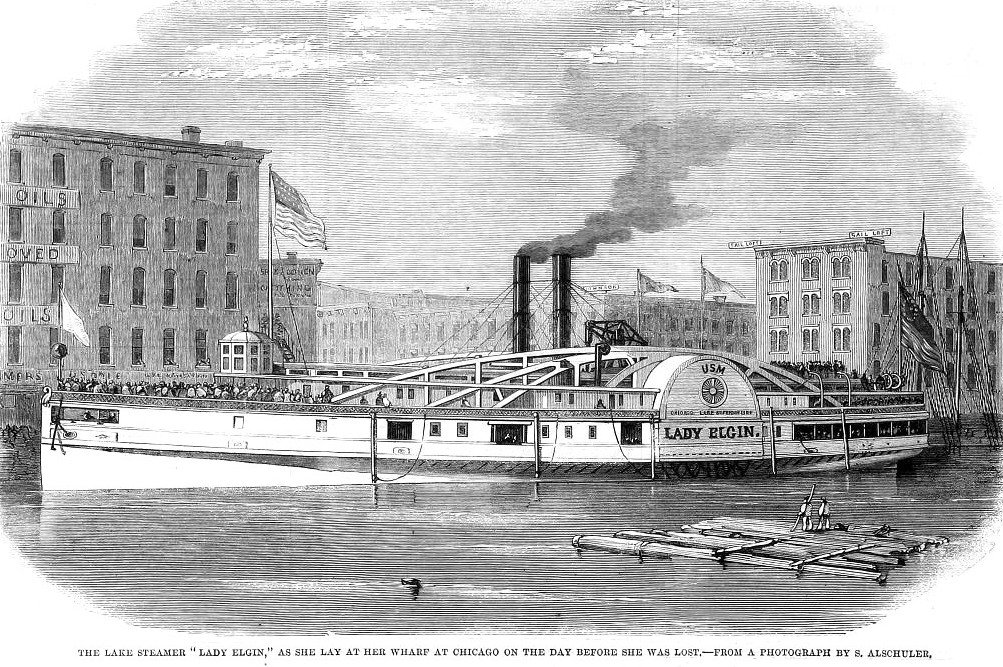
On September 8, 1860, the steamship Lady Elgin, overloaded with passengers on a fundraising excursion, sank on Lake Michigan, an incident which remains the deadliest wreck on the open waters of the Great Lakes (Scanlan 1928; Clark 1946).
“The Lake Steamer ‘Lady Elgin’ as she lay at her wharf at Chicago on the day before she was lost.” From a photograph by S. Alschuler. October 6, 1860. Illustrated London News. Page 307.
I've known since I was quite young that my great-great-grandmother's brother, John L. Campion, died on the Lady Elgin, but I was unaware of the complex political situation that led up to the wreck. Researching the disaster was like peeling an onion. Each layer I turned up revealed more information, and much of it was disturbingly familiar.
When you look back far enough, the loss of life on the Lady Elgin can be directly traced to the Fugitive Slave Act of 1850. This law required that escaped slaves living in free states be returned to their enslavers and made it a criminal act to assist an escaped slave. It allowed officials to deputize citizens and federalize local militias, then force them to aid in the capture and return of an escaped slave. With this law in place, free state residents could no longer see the enslavement of human beings as a practice only condoned in the South. For many Northerners, even those who were not proponents of abolition, this law took things too far. It forced them to participate in slavery (Scanlan 1928; Parrish 1993; Baker 2006).
Cases of escaped slaves captured and tried under the Fugitive Slave Act began to generate national publicity and violent protests, which in turn led to the involvement of the military and federalized state militias. In 1854, for example, fugitive slave Anthony Burns was captured and tried in Boston. President Franklin Pierce sent U.S. Marines to Boston to aid police in preventing more violence. After his conviction, Burns was escorted from the courthouse by the marshal's civil posse, an entire state militia artillery battalion, four platoons of Marines, and a company of cavalry (Barker 2013).
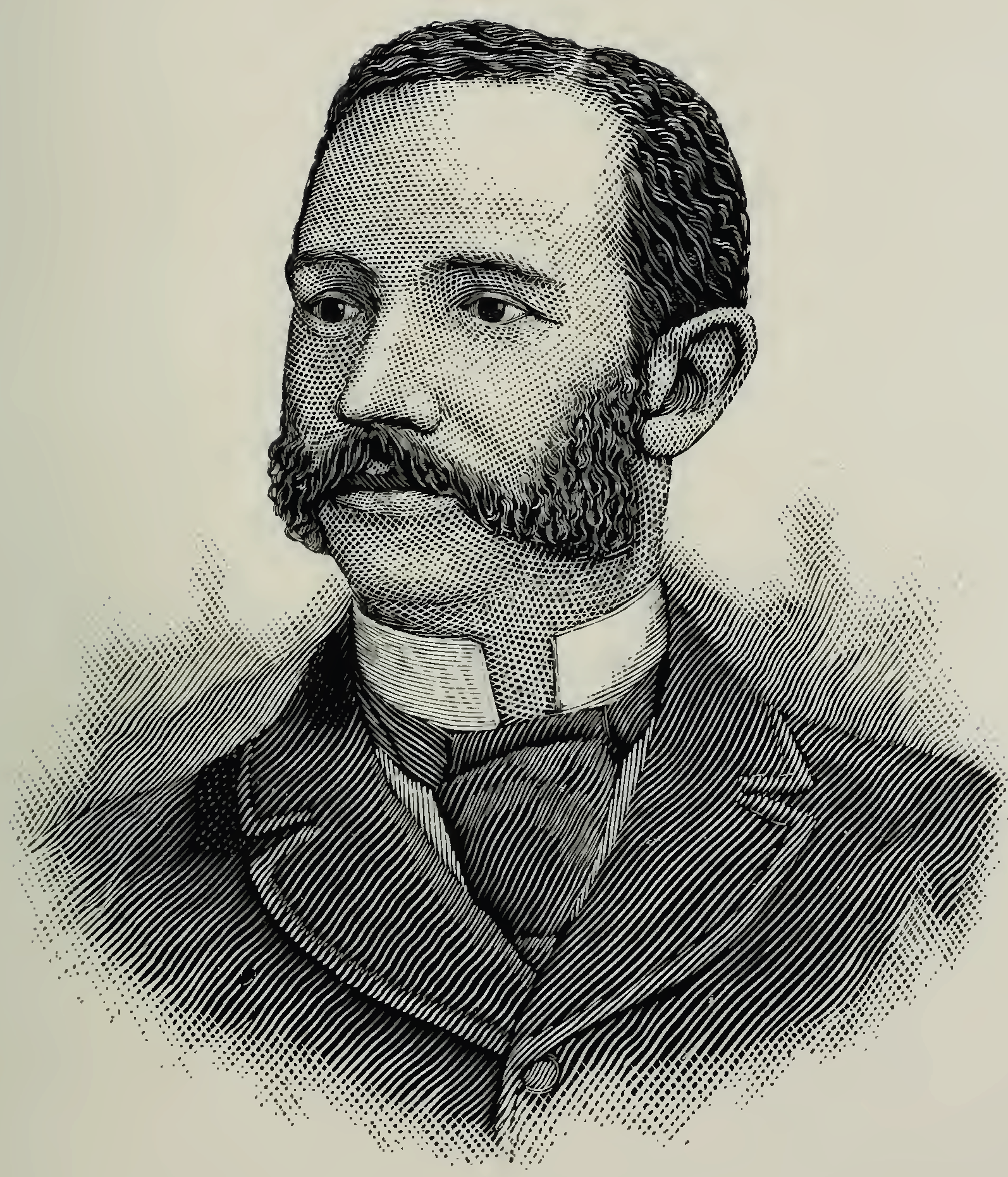
One of the cases that galvanized northern opinions about the Fugitive Slave Act took place in Wisconsin. In 1854, Joshua Glover, who had escaped slavery in 1852, was living in Racine, Wisconsin. On the night of March 10th, his former enslaver, a deputy U.S. marshal, and five other men broke into Glover's home in Racine. They seized Glover, beat him, hand-cuffed him, forced him into the back of a wagon, and took him to jail in Milwaukee. Glover's beating was so severe that warrants were issued for the arrest of the deputy marshal and Glover's previous enslaver on charges of assault and battery (Parrish 1993; Baker 2006; Barker 2013).
“Joshua Glover. The Fugitive Slave.” In C.C. Olin. 1893. A Complete Record of the John Olin Family. Indianapolis, IN: Baker-Randolph Co. Page 429.
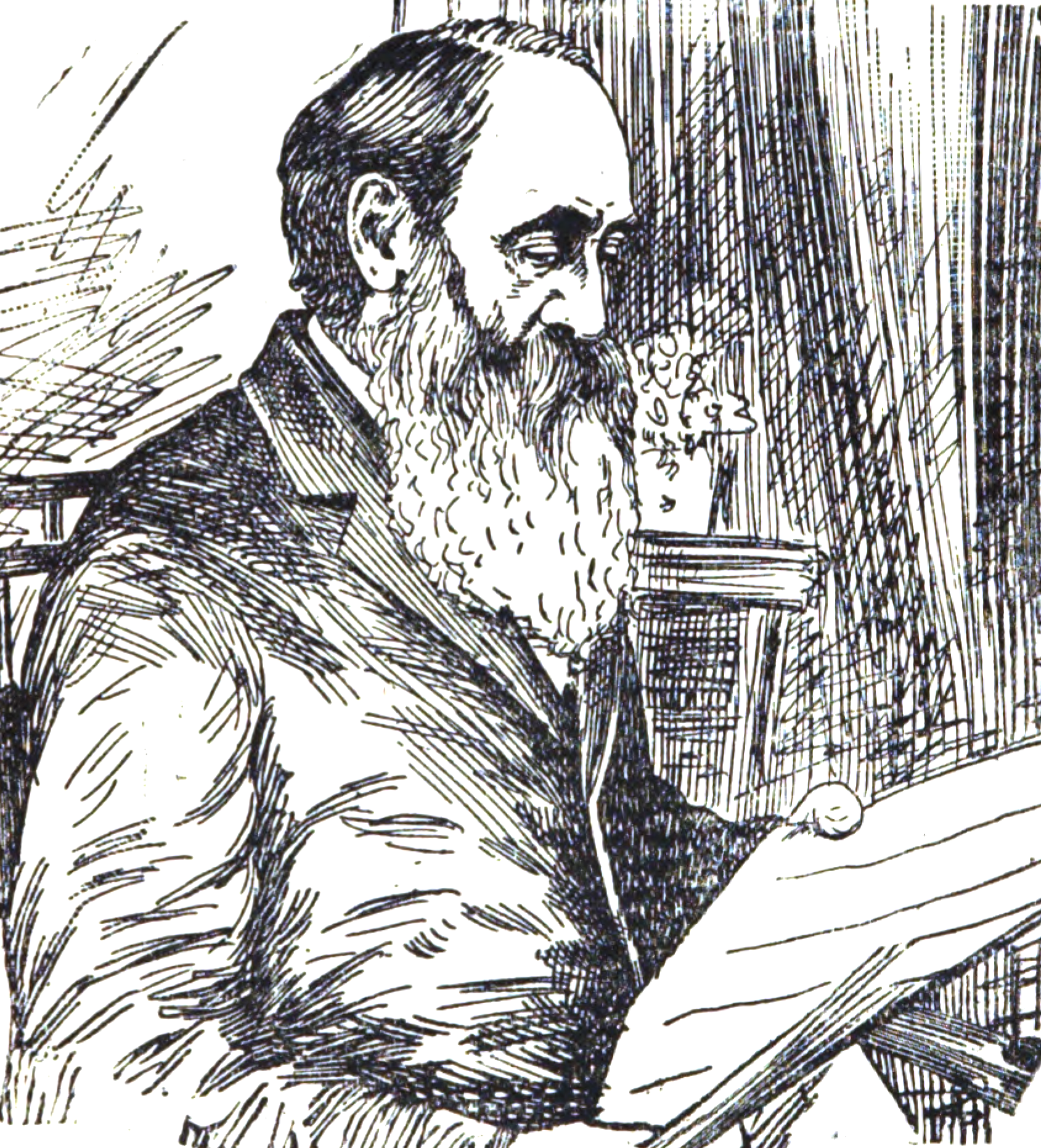
After Glover was jailed, Sherman Booth, an abolitionist, newspaper editor, and politician, spoke before a crowd of people outside the jail, protesting Glover’s imprisonment. Fueled by his words, a mob broke down the jailhouse door, set Glover free, and put him on a boat for Canada, where he spent the rest of his life. Booth was then arrested and charged with abetting the escape of a fugitive slave. Booth’s attorneys took the case to the Wisconsin Supreme Court, which declared the Fugitive Slave Act unconstitutional.
“Sherman M. Booth. From a Recent Photograph.” In Henry E. Legler. 1901. Leading Events of Wisconsin History. Milwaukee, WI: The Sentinel Company. Page 227.
Nonetheless, Booth was tried in federal court, convicted, and sent to prison. The Wisconsin Supreme Court again ruled the law unconstitutional, and Booth was released in 1855. The U.S. Supreme Court agreed to hear the case but was delayed for years when the Wisconsin court delayed sending its decision for them to review (Parrish 1993; Baker 2006; Barker 2013).
In the elections of 1856 and 1858, Wisconsinites clearly demonstrated their views on this issue, electing predominantly abolitionists and/or politicians who opposed the Fugitive Slave Act. In 1857, the state legislature enacted a comprehensive personal liberty law that included writs of habeas corpus, jury trials, and state-provided defense attorneys for fugitive slaves and prohibited the use of state agencies in the recovery of escaped slaves. This law directly conflicted with the Fugitive Slave Act, putting Wisconsin on collision course with the U.S. government (Parrish 1993; Baker 2006).
The standoff came to a head in 1859, when the U.S. Supreme Court ruled that state courts could not overturn a federal law. Booth was rearrested and imprisoned on March 1, 1860, but continued his fight through editorials sent to his newspaper (Parrish 1993; Baker 2006). [1] Some antislavery politicians called for Wisconsin to secede from the Union unless slavery was abolished. On March 3rd, a resolution was introduced in the Wisconsin legislature calling for the state to declare war against the United States (Scanlan 1928; Parrish 1993).
Concerned that the federal government might take command of the state militias and give them orders against the laws of Wisconsin, the governor of Wisconsin disbanded all militia companies he felt might follow federal orders rather than his orders. These militias were private organizations incorporated into the state militia structure. All of their funding was private with the exception of their guns, which were lent by the federal government to the state who then provided them to state militias. So, when these militias were disbanded, they had to return their guns to the state but could continue to operate as private organizations (Scanlan 1928).
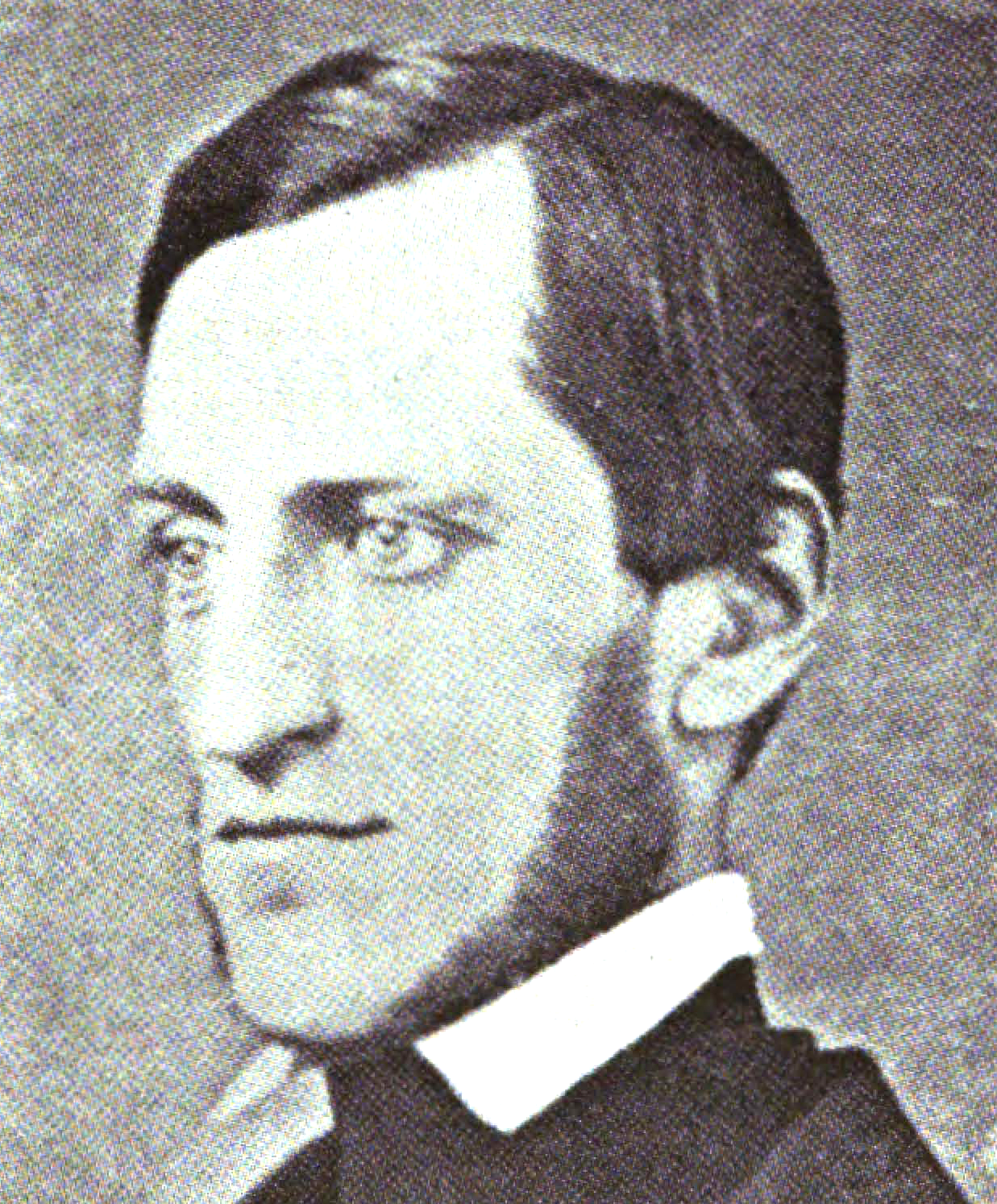
While the governor's actions were legal, they triggered an ugly furor that spread across Wisconsin. At the center of the furor was the Union Guards, a militia company in Milwaukee led by Captain Garrett Barry, a West Point graduate who had served in the Seminole Wars and the Mexican-American War. Barry’s leadership had turned the Union Guards into an outstanding marching and military drill unit, respected throughout the region. They appeared in parades and events as far away as Buffalo, Detroit, and Chicago. Milwaukee was proud of them, enthusiastically supporting their efforts and revering them as hometown heroes (Scanlan 1928).
“Captain Garrett Barry.” In Charles M. Scanlan. 1928. The Lady Elgin Disaster. Milwaukee, Wisconsin. Page 31.
Prior to the governor disbanding militia units, the Wisconsin adjutant general wrote privately to Barry about the "possible contingency" of the Union Guards obeying orders from U.S. authorities versus state authorities. Barry was clear on the legalities. In his reply, he explained that an order by the governor calling militias to act against U.S. authorities would be illegal and would amount to ordering those militias to commit treason for which they "would deserve to be hung” (Scanlan 1928, p. 42). Unsurprisingly, the Union Guards were one of the militias disbanded by the governor a few days later (Scanlan 1928; Clarke 1946).
The governor’s action of disbanding the Union Guards and other militias was by no means universally accepted in the state. Even politicians who supported the possibility of secession felt the governor had gone too far. Throughout the spring and summer of 1860, tensions between antislavery supporters and advocates of following federal law and fighting within the system escalated in increasingly inflammatory news articles. Newspapers from Milwaukee were strongly supportive of the Union Guards and critical of the governor, but many newspapers around the state supported the governor’s actions and were critical of the Union Guards. It was a pressure cooker poised to blow (Scanlan 1928).
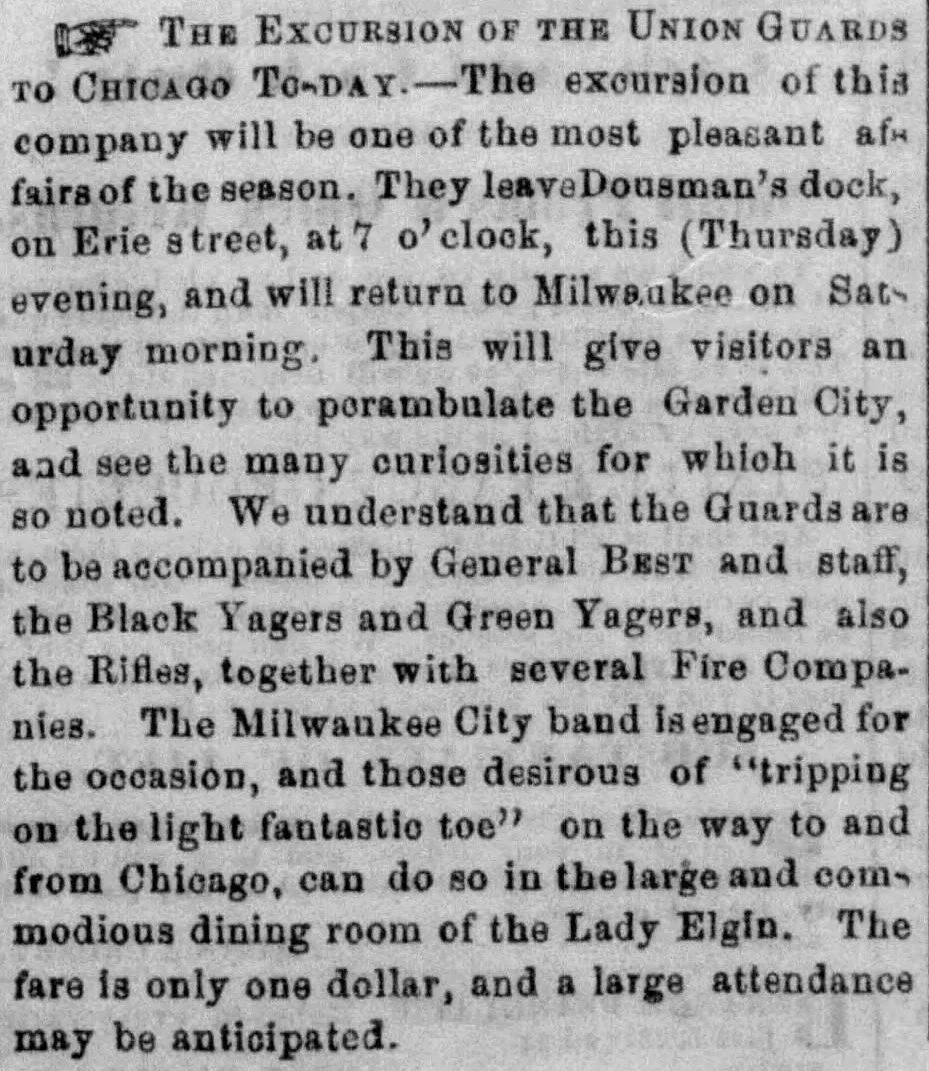
The Union Guards, needing money to replace their guns, organized a fundraising excursion to Chicago to hear political speeches. They would travel aboard the Lady Elgin, with food, music, and dancing. The announcement of the event caused great excitement in Milwaukee. Other local militia companies joined in, and one band became three. When the day of the event came, the ship arrived about three hours late. The hundreds of passengers waiting at the dock simply purchased their tickets and boarded. No comprehensive passenger list was recorded (Scanlan 1928; Clark 1946).
"The Excursion of the Union Guards to Chicago To-Day." September 6, 1860. The Daily Milwaukee News. Milwaukee, Wisconsin. Page 1.
About 2:30am on the morning of September 8th, the Lady Elgin, well lit and steaming through gale force winds on Lake Michigan, was struck on its port side by the schooner Augusta, which had only a single light mounted on a pole, the minimum required by law at that time. Concerned for its own damage, the Augusta fled to Chicago, leaving the Lady Elgin to its fate. The Lady Elgin broke apart and sank within 20 minutes. Dawn came, showing people clinging for their lives on whatever debris they had found. Many died when they encountered breakers near shore (Scanlan 1928; Clark 1946).
The Lady Elgin disaster changed the focus of Wisconsinites for months afterwards. In many disasters, those who were lost are quickly known and fairly quickly recovered. The community can mourn and begin to heal. That was not the case with the Lady Elgin. News stories regularly covered the sheer level of human loss, the families left behind, the orphans created by both parents being among the lost, and the heroic rescues.
These reports continued as more bodies, mostly unidentifiable, were found for months afterwards. Captain Barry's body was found on November 8th, at the head of Lake Michigan in Indiana. A comprehensive list of those thought to have died was not even available until December of 1860 (Scanlan 1928; Clark 1946). [2] So, the impact of the disaster on the hearts and minds of the people in the area was ongoing, similar to the aftermath of modern events such as 9/11 and Hurricane Katrina.
The devastating loss of the Lady Elgin paused the political strife rapidly escalating in Wisconsin earlier in the year. By the time the people of Wisconsin could focus on events other than the Lady Elgin, Abraham Lincoln had been elected president and South Carolina had responded by seceding from the Union on December 20, 1860, completely changing the political landscape. This shift also leaves us with many unanswerable questions. Had the Lady Elgin not been lost, would Wisconsin had seceded from the Union? If so, how would that have changed the Civil War? Had Garrett Barry survived to see the Civil War, would he have volunteered and served the Union? If so, as a former tactical instructor at West Point (who numbered among his students Ulysses S. Grant and William Tecumseh Sherman), how would his tactical skills have aided the Union? These are all questions that are impossible to answer.
The wreck of the Lady Elgin also had a significant impact on Milwaukee. Among the people lost were many members of the militias, the chief engineer of Milwaukee's fire department and members of several fire companies, a number of newspapermen, a candidate for Congress, and a deputy U.S. marshal. Many of those lost were Irish or of Irish descent, not surprising given the makeup of the Union Guard and Milwaukee's Third Ward (Desmond 1930).
What did surprise me was a notice in a Belfast, Ireland, newspaper about the Lady Elgin. The only three people specifically listed were my relatives: John L. Campion, his sister Annie (Campion) O'Grady, and her husband John O'Grady. This newspaper article from Belfast was not an isolated report. The unique circumstances of this particular trip on the Lady Elgin brought together a wide range of passengers, including a Minister of Parliament from England (Scanlan 1928; Clark 1946). So, its sinking changed the nature of the tragedy. Rather than having a mostly regional impact, the loss of the Lady Elgin was also felt nationally and internationally.

"Loss of the Lady Elgin." October 4, 1860. The Belfast Daily Mercury. Belfast, Ireland. Page 3.
[1] On March 10, 1861, seven years to the date after Joshua Glover was seized, Booth's lawyer received an unconditional pardon for Booth from President James Buchanan. It was dated March 2, two days before Buchanan left office (Parrish 1993; Baker 2006).
[2] No list of exactly who died was ever compiled. The estimated number of dead is around 350 people, with 98 rescued. Scanlan (1928) notes 298 bodies recovered and states that the total number of dead may have surpassed 400. Lacking a passenger list and given the challenge of scores of unidentifiable bodies, many of those presumed lost on the Lady Elgin were included in the death list because family or friends knew they had planned to go on the excursion.
Works Cited
Baker, H. Robert. 2006. The Rescue of Joshua Glover. Athens, OH: Ohio University Press.
Barker, Gordon S. 2013. Fugitive Slaves and the Unfinished American Revolution: Eight Cases, 1848-1856. Jefferson, NC: McFarland & Company.
Clark, Dwight F. 1946. “The Wreck of the ‘Lady Elgin’.” Journal of the Illinois State Historical Society 39 (4): 407-418.
Desmond, Humphrey J. 1930, “Early Irish Settlers in Milwaukee.” The Wisconsin Magazine of History 13 (4): 365-374.
Parrish, Jenni. 1993. “The Booth Cases: Final Step to the Civil War.” Willamette Law Review 29 (2): 237-78.
Scanlan, Charles M. 1928. The Lady Elgin Disaster. Milwaukee, Wisconsin.